Now most of you know that Writer’s Effect (Question 2(d) of Paper 1) is the most difficult part of the 0500 First Language English examinations and I’ve received so many questions and comments from those of you out there who have questions about this.
With that in mind, here is a resource I created for every single one of you!
This is a sample response that you can use for the purpose of understanding how to write an effective Writer’s Effect (Question 2(d)) response.
The first sample response is tailored for the Writer’s Effect question in March 2022, Paper 1 Variant 2, and you will need a free or premium membership in order to access it and also the rest of the responses, which are all written to the highest possible specifications according to the rubric and will help you get a clear idea of how to write effectively.
The question is provided – please reference the relevant past year paper and insert in order to understand it – you may get your past papers from online resources such as PapaCambridge or PastPapers.co – download 0500_m22_in_12 and 0500_m22_qp_12 in order to get the question papers. 🙂
Writer’s Effect Sample Answer – March 2022, Paper 1 Variant 2
Sample Answer:
The overall effect of paragraph 4 in “Into the Delta” is to evoke a sense of peace and deep connection with nature. The phrase “utter tranquillity of swishing through the water lilies in the open lagoons” uses auditory imagery to create a serene and calming atmosphere. The description of the mokoro as “gently floating as though blown through the perfectly clear water” further enhances this sense of peacefulness and harmony with the natural world. The imagery of the narrator “lay[ing] back on my backpack” contributes to a feeling of relaxation and being at one with the environment.
Hope you enjoyed that!
The responses are tailored directly to the rubric for P1 and all Cambridge requirements, and they will help you to learn how to write your responses in a way that will meet the criteria and also accomplish the goal of getting yourself the best possible grade.
Join Premium today to access this exciting resource and conquer Writer’s Effect in 2023!
One of the many things that First Language English asks you to do is to learn how to write a summary!
Seems obvious?
Well…
It isn’t, really.
See, when people hear ‘summary’, they immediately think that this means shortening an essay until it becomes something miniature – a compression of a long piece into something bite-sized… But is that what you need to do?
Let’s explore!
In the IGCSE First Language English exam, summary-writing is examined in question 1f).
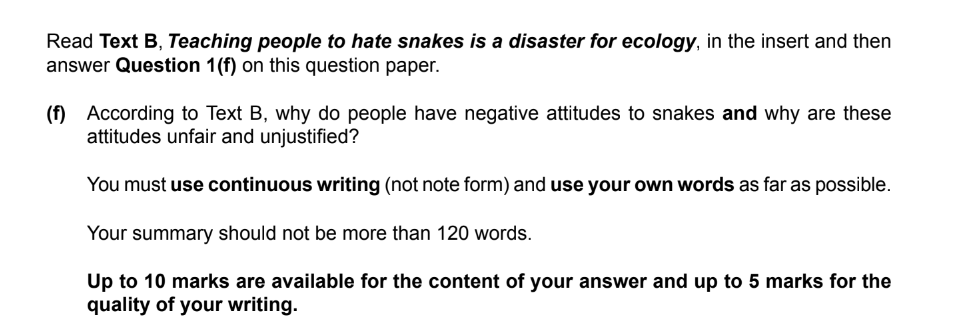
Here’s a text and an example question from Summer 2022, Paper 1, Variant 3, provided here for your consideration:
Alright! We can tell a few things about this:
They’re not asking you to shorten the text.
The text is titled “Teaching people to hate snakes is a disaster for ecology”, and the question is asking you “why do people have negative attitudes to snakes and why are these attitudes unfair and unjustified?”. You should be answering the question, not looking at every sentence and trying to find a ‘shorter’ way of writing it.
They are asking you to find specific points in the text that answer the question.
You are looking for points that answer the specific question that was being asked. “Humans often fear what they don’t understand” is a good point to note – we don’t need to know about the Zoo Chats or anything else in the third paragraph as that doesn’t answer the question.
They are asking you to cut out irrelevant points.
Not everything in the text is relevant – If I’m receiving a summary from someone titled “Why people have negative attitudes towards snakes and why these attitudes are unfair and unjustified”, I’m not going to care about when World Snake Day is or anything else.
To effectively write a summary for IGCSE First Language English and obtain the highest possible score in an exam, follow these steps:
Read the task prompt:
You have no idea how many summaries I have read in my lifetime that didn’t work because the student just went and tried to shorten the text. Please don’t do this – instead, please read the task prompt.
No matter what, your summary needs to match the question, and you need to make sure that it addresses the essential points of the question.
This is crucial, because you are not trying to shorten the entirety of the text – you are looking for the points that respond directly to the question, and hence you will have to select those points out.
Read the passage carefully:
Remember the task prompt, then thoroughly read the given passage to fully understand its content, context, and main ideas.
Identify key points:
As you read, make note of the main points and any supporting details in relation to the task prompt – i.e. since they’re asking “Why people have negative attitudes towards snakes and why these attitudes are unfair and unjustified”, look for parts of the text where you can find answers to those specific questions.
Highlight them, then start thinking about how you can arrange or combine them into your summary.
Organize your ideas:
Once you’ve managed to decide which points belong in your summary, group the main points and supporting details in a logical order that supports the prompt. Note that often, this will cause you to end up with a chaotic list of things – so you need to start thinking about how you are going to combine the points with one another.
Paraphrase:
By this point, you have a list of points highlighted on the insert – now, you have to think about how to combine them into concise sentences that capture what you need.
Note that often, less is more.
Keep it concise:
A summary should be brief and to the point.
Aim to include only the most important information, and avoid any unnecessary details, examples, or personal opinions.
When in doubt, look at any part of your summary and ask:
“Does this answer the question?”
Use appropriate language:
Avoid slang, contractions, and colloquialisms.
Review the task prompt:
As you write your summary, continually refer back to the task prompt to ensure you’re addressing all requirements. This will help you stay focused and avoid straying from the task at hand.
Edit and proofread:
Once you’ve written your summary, take the time to carefully review and edit it. Look for any errors in grammar, punctuation, or spelling, and correct them as needed.
Oh wait, what’s that? The last tip?
Practice:
This is probably common sense, but in case it’s not… Practice!
Showing up makes a difference even if you don’t notice that it’s happening – let yourself have the time and space to process things in your mind, and keep doing it even if you don’t immediately see the results; that’s how you give yourself the opportunity to grow and get better at this, one step at a time.
Scheduling a good time for yourself or even using ChatGPT to remind yourself can be helpful, and so is doing the summary task under timed conditions – it might be hard at first to finish in the given time and you may overshoot, but trust your brain and its ability to learn: That’s why we’re here, and that’s something that is perfectly in your capacity.
And that’s it for now!
We hope you enjoyed this piece – enjoy, and have a wonderful one ahead!
Examiner Reports are released by Cambridge International after each examination session. These reports summarize the general performance of students, highlight common strengths and weaknesses, and provide constructive feedback for both students and teachers.
Put simply?
They’re awesome, and if you want to do well on the IGCSE, you should read them.
In this blog post, we will discuss the immense value of reading Examiner Reports for the IGCSE First Language English 0500 examination and how they provide invaluable insights into what examiners are looking for.
At the same time, they reflect the overall judgement of examiners for the essays of students for particular examination sessions and therefore provide key insights into the way that Cambridge as an organisation evaluates different scripts, which in turn can help you to better contextualise the marking criteria that has been provided in the mark scheme documents that you have no doubt seen so far.
“But Victor!!!” you might be saying…“I don’t want to spend my time reading dumb stuff like that!!!!”
Well hold on, hold on.
What if I told you that this ‘dumb stuff’… Was actually one of the master keys towards unlocking excellence on the IGCSE First Language English exam?
Unlocking the Marking Criteria
One of the difficulties of understanding how to do well in a language-based exam for students is that there are various ways to operationalize excellence in language. While it’s true that for other exams such as mathematics and science exams some degree of creativity and insight can lead to novel approaches and answers, it remains true that the possible sample space of excellent responses for First Language English and other exams is much wider, and it also remains true that it is more difficult for students to understand how to operationalize excellence through their work just from reading the marking criteria.
Here is where the \magic/ 🪄 of examiner reports comes in!
Examiner reports are absolutely invaluable in helping you to unlock the marking criteria for the IGCSE First Language English exam, because they offer comprehensive and actionable steps for you if you’re practicing for the exam, and they serve as a wonderful practice aid for you to check whether you are able to do well in particular practice exams.
Let’s look at the first part of the examiner report for the June 2022 IGCSE.
Observe here that there are key messages for each paper, and also general comments about what constituted excellence for the paper. We won’t discuss the entire thing, but there are also specific analyses on a question-by-question basis.
I won’t go into everything here today (more resources will be provided to our Premium members soon).
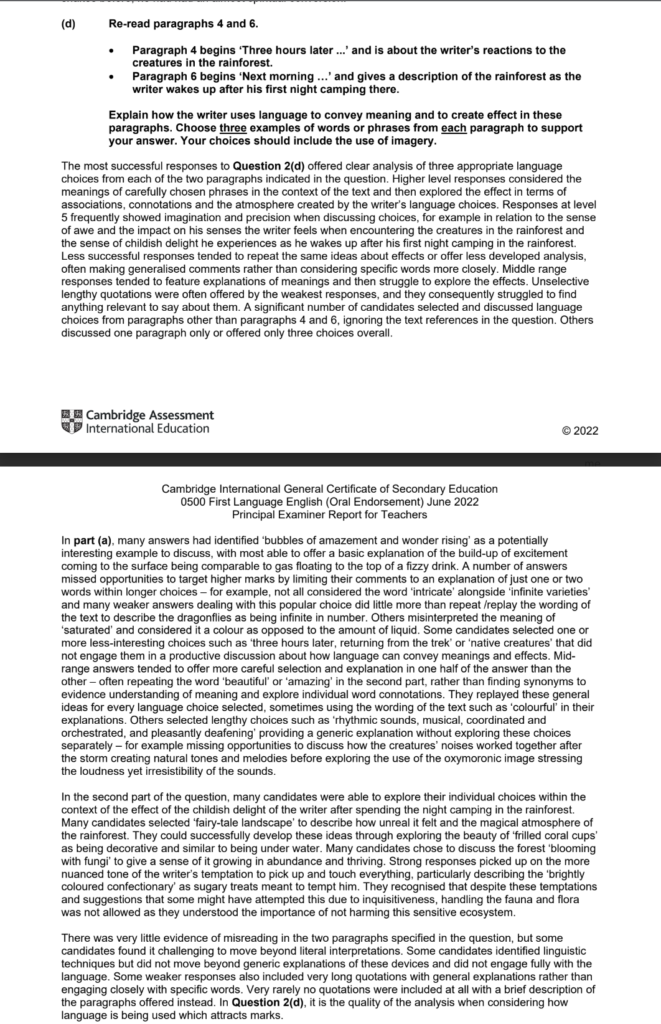
Here’s one sample:
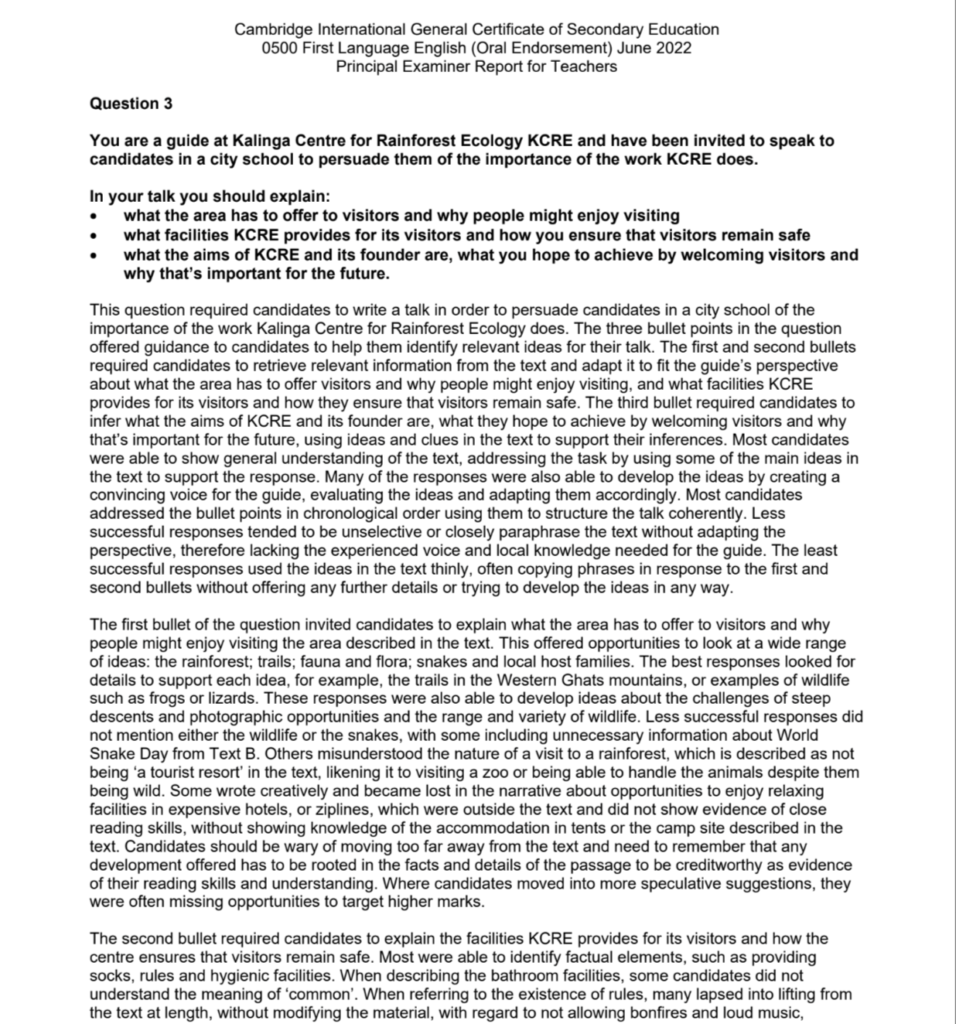
…And here’s the next:
Wow.
As you can see, the report specifically breaks down these questions.
Think about that and the value that it’s offering – in the first case, it is telling you exactly how the best candidates did question 2d) and how they came to deliver responses on Writer’s Effect.
In the second example, it is literally breaking down Question 3 for you by telling you the ways in which the candidates approached the question and the way that people thought about the question, which you can in turn reference as you write your own exam responses; you could implement a routine of practicing a past paper, following that up by having your essay graded (submissions for essays to our essay bank(s) are open!)
To sum up, why are examiner reports valuable to you?
(sorry to be annoying, but you’ll have to sign up for a free or premium membership to read the next bit c: – reminder that purchasing the book gains you access to premium member privileges… For now!)
To view this content, please sign up for a membership!
If you haven’t signed up yet, make sure to Join Now!
I hope I’ve shown you that Examiner Reports for the IGCSE First Language English 0500 examination are a powerful tool for students seeking to understand what examiners are looking for in the context of the marking criteria, and also that they are something valuable to look at in your quest for mastery or for convergence towards writing stellar essays that fit the marking criteria while at the same time helping you to excel.
By analyzing these reports, students can gain invaluable insights into the expectations of examiners, avoid common pitfalls, learn from real examples, and fine-tune their writing techniques to achieve the highest possible marks.
As the saying goes, knowledge is power, and in the case of the IGCSE First Language English 0500 examination, Examiner Reports are a key to unlocking that power – they are not the only key, but are definitely something that you should consider as part of your repertoire!