Assessment

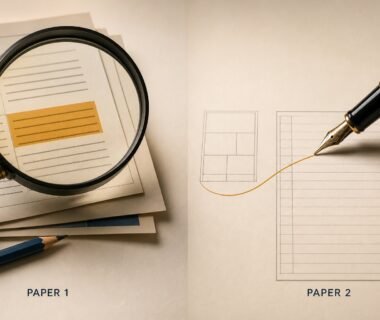
Paper 1 vs Paper 2: What Each Paper Is Actually Testing

Victor Tan
 

Why Paper 1 is not simply comprehension, Paper 2 is not simply creative writing—and revising both in the same way is a mistake.

Syllabus note: This article follows the Cambridge IGCSE First Language English 0500 syllabus for examinations in 2027, 2028 and 2029. If you are sitting the examination in 2026, some question numbers and mark allocations will be different.

Welcome back, all!

Paper 1 and Paper 2 look rather like siblings.

Each lasts two hours. Each carries 80 marks. Each contributes exactly half of your final grade.

But they are not twins.

Paper 1 asks whether you can hear what a text is really saying—even when its most important meanings are not stated directly.

Paper 2 asks whether you can make language say precisely what you intend.

One rewards disciplined interpretation. The other rewards deliberate authorship.

If you revise both papers by simply “doing more essays”, you are training two rather different sets of muscles as though they were one.

So what is Cambridge actually testing?

Let’s take a closer look.

The short answer: reader first versus writer first

The numerical contrast is remarkably neat:

PaperReading marksWriting marksCentral demand
Paper 16515Understand, select, infer, analyse and transform
Paper 21565Evaluate, organise, craft and control

Together, the two papers provide:

  • 80 Reading marks
  • 80 Writing marks

The qualification as a whole is perfectly balanced. The individual papers are not.

Paper 1 is reading-led, but still requires controlled writing. Paper 2 is writing-led, but still requires critical reading.

A useful way of expressing the distinction is this:

Paper 1 asks: What does this text allow you to say?

Paper 2 asks: Given this purpose and audience, what is the best thing to say—and how should you say it?

The mark allocations come directly from Cambridge’s official 2027–29 syllabus.

For the complete question-by-question structure, see the companion guide to the Cambridge IGCSE 0500 exam format for 2027–29.

What Paper 1 is actually testing

Paper 1 is not testing how much of the text you can copy.

Nor is it testing how many literary techniques you have memorised.

It is testing whether you can move from seeing, to understanding, to explaining, and finally to re-voicing a text.

Can you notice precisely?

Question 1 tests much more than basic retrieval.

You may need to:

  • Locate an explicit fact
  • Recognise an implied meaning
  • Explain a phrase in your own words
  • Distinguish between similar ideas
  • Select information for a particular purpose
  • Explain why the writer chose one expression rather than another

A careless reading error at the beginning can quietly damage everything that follows.

This is why a polished sentence does not rescue an answer to the wrong question. In Paper 1, precision comes before elegance.

If short-answer questions are costing you marks, begin with the broader guide to Reading Comprehension in IGCSE Paper 1.

Can you paraphrase without changing the meaning?

“Use your own words” does not mean replacing every word with something that sounds more sophisticated.

It means preserving an idea while changing its language.

That requires genuine understanding.

If you replace a word mechanically using a thesaurus, you may produce a sentence that sounds impressive but means something slightly—or completely—different.

Paper 1 therefore tests whether you can separate an idea from the wording in which you first encountered it.

This is central to both comprehension and summary writing.

Can you select rather than collect?

The summary task is one of the clearest tests of disciplined selection.

A weak candidate often asks:

How many things from the passage can I include?

A stronger candidate asks:

Which ideas answer this exact question?

Those are very different questions.

Cambridge rewards a relevant range of distinct ideas, careful selection, clear organisation and concise expression. Excess material can be just as damaging as missing material because it suggests that the candidate has not distinguished the essential from the merely interesting.

The same principle appears in the Extended Response. Using more details does not automatically demonstrate greater understanding. The details must be relevant, developed and adapted to the task.

Paper 1 rewards compression with fidelity: you control the selection and organisation, but the source still controls the underlying content.

Can you explain how language works?

Writer’s Effect is not a treasure hunt for metaphors.

The examiner is not awarding marks because you correctly identified personification and then moved on.

A strong analysis explains:

  • What the selected word or phrase means in context
  • What associations or connotations it carries
  • What image it creates
  • Why the writer’s choice is effective
  • What the language contributes to the wider portrayal or atmosphere

The official Paper 1 specimen mark scheme makes an important point: the quality of analysis matters more than simply accumulating quotations.

Three precise, well-explained choices are more valuable than six quotations surrounded by vague comments.

If your analysis repeatedly says that something “creates an image in the reader’s mind”, revisit the Writer’s Effect marking-criteria deep dive.

Can you transform a text without escaping it?

Question 4, the Extended Response to Reading, can look rather creative.

You may be asked to write an interview, journal, speech, report, article or letter. You must adopt a role, establish a voice and develop ideas.

But it is not free creative writing.

The source remains the authority.

Your role, structure and expression may be imaginative, but the substance must remain grounded in Text C. Relevant implications can be developed; an entirely unrelated story cannot.

I sometimes see students become so enthusiastic about the role that they gradually abandon the passage. The response becomes lively and fluent—but earns few Reading marks because it no longer demonstrates what the candidate understood.

This is constrained creativity.

You have freedom over voice, organisation and development, but not freedom to betray the source.

Does spelling and grammar matter on Paper 1?

Here is an important technical distinction.

Paper 1 does not separately assess W5, the objective for spelling, punctuation and grammar.

That does not mean accuracy is irrelevant.

The summary still rewards clear, fluent and concise expression. Question 4 still rewards style, structure, vocabulary and language appropriate to audience and purpose. If an examiner cannot understand your sentence, they may not be able to credit the idea inside it.

So there is no separate SPaG assessment on Paper 1—but unclear writing can still conceal good reading.

What Paper 2 is actually testing

Paper 2 gradually hands the pen to you.

Section A still provides source material, but you must reorganise it around your own purpose and judgement.

Section B then removes the source altogether. You must generate, select and control the material yourself.

Paper 2 tests whether you can move from judging, to deciding, to shaping, and finally to controlling a piece of writing.

Can you judge ideas rather than repeat them?

Paper 2 begins with source material, but it is not another comprehension paper.

The five-mark Question 1(a) requires a short analytical or evaluative response. Question 1(b), Directed Writing, then asks you to use, develop and evaluate ideas from the text or texts.

Evaluation does not mean disagreeing with everything.

It may involve:

  • Testing whether a claim is convincing
  • Identifying an assumption
  • Recognising a limitation
  • Comparing competing viewpoints
  • Qualifying an overly simple argument
  • Exploring the consequences of an idea
  • Deciding which position is most useful or reasonable

A response that merely reports what each writer says has not yet begun to evaluate.

For more on this distinction, revisit How to Evaluate in IGCSE First Language English.

Can you synthesise different viewpoints?

A weak Directed Writing response often follows this structure:

  • Text A says…
  • Text A also says…
  • Text B says…
  • Text B disagrees…
  • In conclusion…

The source texts have become the paragraph plan.

Cambridge’s Paper 2 specimen mark scheme explicitly identifies reliance on the sources’ original sequence as a feature of lower-level writing.

A stronger response groups ideas by issue.

It might bring one claim from Text A together with a qualification from Text B, test both and then develop an independent judgement.

The goal is not to display the sources one after another. It is to assimilate them.

The sources provide the raw material. You decide what to build.

Can you control audience, purpose and form?

An idea should not sound identical in every context.

Advice written for teenagers entering the workplace should sound different from a formal report addressed to a school leadership team. A persuasive speech should not read like an academic essay with “Ladies and gentlemen” added to the first line.

Audience and purpose affect:

  • Vocabulary
  • Sentence structure
  • Tone
  • Level of formality
  • Organisation
  • Methods of engagement
  • The balance between explanation and persuasion

Register is not decoration. It is part of meaning.

Before practising another directed response, make sure you understand the possible forms using the complete 0500 text-types breakdown.

Can you create and shape material independently?

In Section B, you choose one descriptive or narrative title and create the entire response.

There is no source passage to provide ideas. There is no list of content points waiting to be discovered.

You must decide:

  • What the central concept will be
  • What to include and exclude
  • Where the focus should move
  • How the response should develop
  • What the reader should notice or feel
  • How the ending should relate to the beginning

This is why a composition with an interesting premise can still receive a modest mark.

An idea is not yet a piece of writing.

It must be selected, structured, developed and expressed with control.

If your responses tend to begin energetically and then lose direction, revisit Should You Plan Your Essays?.

For genre-specific preparation, see the descriptive writing guide and the guide to narrative story structures.

Can you sustain technical control?

Unlike Paper 1, Paper 2 explicitly assesses spelling, punctuation and grammar across all 65 Writing marks.

In Directed Writing, the 25 Writing marks reward:

  • Style
  • Structure
  • Vocabulary
  • Audience and purpose
  • Accuracy

In Composition, the 40 marks are divided into:

  • 16 for Content and Structure
  • 24 for Style and Accuracy

That does not mean there are a few separate grammar marks waiting to be collected at the end. The criteria are holistic. Accuracy operates alongside meaning, structure and effect.

Ambitious vocabulary used inaccurately is not sophisticated writing.

A complex sentence that collapses halfway through is not automatically better than a controlled simple one.

Paper 2 rewards deliberate language choices that work.

Paper 1 versus Paper 2

DimensionPaper 1Paper 2
Primary roleCritical readerDeliberate writer
Main questionWhat does the text allow me to say?What should I say, and how should I say it?
Relationship to sourcesClosely anchored to supplied textsSource-led in Section A; independent in Composition
Core actionsUnderstand, infer, select, analyse, transformEvaluate, synthesise, argue, imagine, craft
FreedomConstrained by textual evidenceIncreasing freedom across the paper
Own wordsDemonstrate genuine understandingBuild an independent argument and voice
CreativityDevelop within the source’s boundariesGenerate and control original material
StructureServes selection, bullet coverage and textual transformationServes audience, purpose and reader experience
AccuracyNo separate W5 assessment, but clarity mattersW5 is directly assessed throughout
Typical weak responseCopies, misreads, generalises or inventsRetells sources, rambles, loses register or lacks control
Best focused practicePrecise reading and analysis drillsPlanning, drafting, editing and redrafting

The two papers quietly train each other

Paper 1 and Paper 2 are different, but they are not sealed revision boxes.

Each can improve the other:

  • Summary writing teaches concision that strengthens Paper 2 arguments.
  • Writer’s Effect develops the vocabulary awareness needed for composition.
  • Paper 1 Question 4 develops voice and register for Directed Writing.
  • Directed Writing evaluation strengthens Paper 1 attitude and inference work.
  • Composition planning improves the structure of every extended response.
  • Paper 2 editing habits improve clarity throughout Paper 1.

The best preparation therefore recognises both the differences and the connections.

Which skill is your mark exposing?

Do not respond to every disappointing result by completing another full paper.

First, diagnose the underlying weakness.

What keeps happening?Likely weaknessBest repair
You understand the passage but lose summary marksSelection and compressionHarvest, group and paraphrase points
Your language analysis sounds repetitiveContextual interpretationAnalyse one choice deeply before adding another
Your Extended Response becomes a new storySource disciplinePlan evidence before development
Your Directed Writing retells both textsEvaluation and synthesisGroup ideas by issue and test each claim
Your compositions contain ideas but feel shapelessDeliberate structureMap the purpose of each scene or paragraph
Your writing sounds ambitious but contains frequent errorsTechnical controlUse targeted editing passes
You regularly answer a slightly different questionTask precisionUnderline command words, audience and purpose

This is the principle behind intelligent practice: identify the problem, isolate it, correct it and then test whether the improvement transfers.

How should you revise each paper?

For Paper 1

Prioritise:

  • Short comprehension and inference drills
  • Accurate paraphrasing
  • Summary-point selection
  • Precise language analysis
  • Evidence-to-development planning
  • Careful reading of command words
  • Marking against the exact paper-specific mark scheme

Do not assume that longer answers are automatically stronger. On Paper 1, excess can reveal weak selection just as easily as brevity can reveal missing understanding.

For Paper 2

Prioritise:

  • Evaluating claims rather than merely identifying them
  • Grouping source ideas by issue
  • Planning for audience, purpose and form
  • Writing controlled paragraphs
  • Developing descriptive and narrative structure
  • Editing for sentence boundaries, tense, punctuation and precision
  • Redrafting weak sections rather than merely starting another essay

Alternate targeted practice with occasional complete timed papers. Full papers test stamina and timing; focused drills are often better for repairing a specific weakness.

So which paper is harder?

There is no universal answer.

A fluent, imaginative writer may enjoy Paper 2 but lose Paper 1 marks through imprecise reading.

A careful, analytical reader may perform strongly on Paper 1 but struggle when asked to generate and sustain independent writing.

A highly creative student may need to learn source discipline. A formula-reliant student may cope with short questions but struggle when judgement is required.

The harder paper is usually the one that exposes the skill you have been able to avoid practising.

And perhaps that is the real value of the two-paper structure.

Paper 1 asks you to read with discipline.

Paper 2 asks you to write with intention.

The best students learn to do both.

Your next step

Once you understand the difference between the papers, practice stops being random.

You can choose a task because it develops the skill you need—not merely because it happens to be the next question in the booklet.

If worked examples and a regular feedback loop would help you practise more intelligently, you can explore EnglishFirstLanguage.net Premium membership and learn about the IGCSE Essay Marker.

Paper 1 rewards fidelity with intelligence.

Paper 2 rewards freedom with control.

All the best!

V.
Official Cambridge sources

IGCSE English 0500 Coursework: Your Complete Guide to Component 3

Victor Tan
 

Today we’re diving deep into one of the most misunderstood aspects of IGCSE English First Language 0500: the coursework option.

Whether you’re a student trying to figure out which assessment route is right for you, a parent trying to understand what your child is getting into, or a teacher weighing up the pros and cons of offering coursework at your school, this post is going to give you everything you need to know about Component 3 – the Coursework Portfolio.

And here’s the thing: some of you reading this might not even know that coursework is an option. Some schools automatically put everyone through Paper 2, while others swear by coursework. We’ll get into why that is, but first, let’s look at what we’re actually dealing with.

The Official Specification

Before we go any further, let me give you the official documentation.

If you want to dive into the nitty-gritty details yourself, here is an essential resource: the Coursework Handbook.

I strongly recommend downloading that Coursework Handbook. It’s got marked examples, moderator comments, and basically everything you need to understand what good coursework actually looks like.

Don’t just skim it – actually read it, especially if you’re planning to take the coursework route.

Having said that…

What Actually IS Coursework?

Let’s get the basics straight. In IGCSE English 0500, you have two options for your written assessment:

Option 1: Paper 1 (Reading) + Paper 2 (Directed Writing and Composition)
Option 2: Paper 1 (Reading) + Component 3 (Coursework Portfolio)

Both options are worth the same (50% from each component), and both give you access to the full range of grades from A* to G.

The coursework isn’t some “easier” route or a consolation prize for weaker students – it’s a legitimate, rigorous alternative that tests the same skills in a different way, but that some schools or students might prefer.

Why Would Someone Choose Coursework?

This is the million-dollar question, isn’t it? Why would you – or your school – opt for coursework instead of just sitting the exam like everyone else?

The Student Perspective

Let me be honest with you: coursework isn’t for everyone, but for some students, it’s absolutely the right choice. Here’s why:

1. Time to Perfect Your Work

With Paper 2, you walk into an exam hall, you get 2 hours, and whatever you write is what you get marked on. There’s no going back, no second chances, no “wait, I could have said that better.”

With coursework, you get to draft, redraft, refine, and polish. You can take feedback (within limits – more on that later), sleep on your ideas, and come back with fresh eyes. If you’re the kind of person who thinks of the perfect phrase in the shower three days after the exam, coursework might be your friend.

2. Control Over Your Topics

Paper 2 gives you some choice, sure, but you don’t know what the prompts will be until you open the exam paper. With coursework, you get to choose topics that genuinely interest you, that connect to your life, your culture, your experiences.

This isn’t just about making the work easier – it’s about making it better. When you write about something you actually care about, something that resonates with your lived experience, the quality of your writing tends to be substantially higher. Your narrative about navigating cultural identity in Malaysia will be more authentic and compelling than a generic story about a haunted house that you’ve never experienced.

3. Reduced Exam Pressure

Some students just don’t perform well under timed exam conditions. Maybe you freeze up, maybe you second-guess yourself, maybe you just write slower than the exam allows. Coursework removes that artificial time pressure and lets you work at your own pace.

4. Building a Body of Work

There’s something deeply satisfying about having a completed portfolio at the end of your course. It’s tangible evidence of your growth as a writer. You can look back at your three pieces and see the different skills you’ve mastered, the different voices you’ve tried out.

The School Perspective

Now, why might schools choose to offer – or not offer – coursework? This is where it gets interesting.

Schools that prefer coursework often argue:

  • It’s more authentic assessment of writing ability
  • It allows for differentiation (stronger students can tackle more complex topics)
  • It reduces the “exam factory” feel of IGCSE preparation
  • It develops independent learning skills
  • Students produce work they’re genuinely proud of

Schools that avoid coursework often cite:

  • Administrative burden (internal moderation, external moderation, paperwork)
  • Plagiarism concerns (more opportunities for dishonesty)
  • Difficulty ensuring all work is the student’s own
  • Challenges in managing the drafting process appropriately
  • Inconsistency in marking standards across different teachers

Neither position is wrong. It’s about what works for your school’s context, your student population, and your staff capacity.

Coursework vs. Paper 2: The Commonalities

Here’s what you need to understand: the skills being tested are identical.

Whether you’re sitting Paper 2 or submitting coursework, Cambridge is assessing your ability to:

Writing Assessment Objectives (W1-W5):

  • W1: Articulate experience and express what is thought, felt and imagined
  • W2: Organise and structure ideas and opinions for deliberate effect
  • W3: Use a range of vocabulary and sentence structures appropriate to context
  • W4: Use register appropriate to context
  • W5: Make accurate use of spelling, punctuation and grammar

Reading Assessment Objectives (tested in Assignment 1 only):

  • R1: Demonstrate understanding of explicit meanings
  • R2: Demonstrate understanding of implicit meanings and attitudes
  • R3: Analyse, evaluate and develop facts, ideas and opinions
  • R5: Select and use information for specific purposes

The mark distribution is also identical:

  • Paper 2: 40 marks for Directed Writing + 40 marks for Composition = 80 marks total
  • Coursework: 30 marks for Assignment 1 + 25 marks for Assignment 2 + 25 marks for Assignment 3 = 80 marks total

Both routes test your ability to:

  • Write persuasively/argumentatively in response to stimulus material
  • Write descriptively
  • Write narratively

The genres, the text types, the language skills – all the same. The only difference is how you demonstrate those skills.

Coursework vs. Paper 2: The Key Differences

But of course, there are significant differences in how these assessments work:

1. Time Constraints

Paper 2: You have exactly 2 hours to complete both tasks. Time management is crucial. You need to plan quickly, write efficiently, and have no time for extensive revision.

Coursework: You have months (potentially the entire two-year course) to complete your portfolio. You can spend as much time as you need on each piece, though practically, you’ll be balancing this with your other subjects.

2. Drafting Process

Paper 2: What you write is what you get. You might do a quick plan, but there’s no opportunity to draft, get feedback, and redraft.

Coursework: You’re required to submit one first draft with your portfolio. You can plan extensively, write a first draft, receive general feedback from your teacher (though they can’t correct specific errors), and then produce a polished final version.

3. Topic Selection

Paper 2: You choose from the options provided on the exam paper. You don’t know what these will be until exam day, though you can practice with past papers to get a sense of the types of questions asked.

Coursework: You and your teacher negotiate the assignments together and even select texts together. While there are guidelines about what each assignment must achieve, there’s significant flexibility in choosing topics that interest you and suit your abilities.

4. Use of Resources

Paper 2: No dictionaries, no notes, no reference materials. Just you, the exam paper, and your brain.

Coursework: You can use dictionaries, spell-checkers, thesauruses – any resources that help you polish your work. You can research your topics, gather ideas, and draw on a wide range of materials to inform your writing.

5. Stakes and Stress

Paper 2: Everything rides on your performance on one specific day at one specific time. If you’re having an off day – headache, personal problems, just didn’t sleep well – that’s tough luck.

Coursework: Your performance is spread out over time. A bad day doesn’t ruin everything because you can come back to your work when you’re feeling better.

6. Assessment Mode

Paper 2: Externally assessed by Cambridge examiners. Marked anonymously and consistently according to standardized mark schemes.

Coursework: Internally assessed by your teachers, then externally moderated by Cambridge. Your teachers mark your work first, then Cambridge checks a sample to ensure the marking is fair and consistent.

Breaking Down the Three Assignments

Let me give you the quick overview of what you actually have to produce:

Assignment 1: Writing to Discuss, Argue and/or Persuade (30 marks)

This is your “directed writing” equivalent. You’ll respond to a text or texts (about 2 sides of A4) chosen by your teacher. You need to:

  • Select, analyze, and evaluate the ideas and opinions in the text
  • Integrate those ideas with your own views
  • Write in an appropriate form (letter, article, speech, etc.)

Word count: 500-800 words
Marks: 15 for reading, 15 for writing

Example topics that work well:

  • “University: why bother?” – you write a letter to the author arguing for or against their position
  • “Why social media should be banned for under 16s” – you respond evaluating the author’s arguments
  • “Bringing up Chinese children” – you discuss the parenting approaches presented

The key here is that you’re not just summarizing what the text says – you’re engaging with it critically, evaluating the arguments, and presenting your own perspective.

Assignment 2: Writing to Describe (25 marks)

This is pure descriptive writing – non-narrative. You’re creating images, atmosphere, and feelings through language.

Word count: 500-800 words
Marks: 10 for content and structure, 15 for style and accuracy

Example topics:

  • Describe your surroundings and feelings while waiting for someone in a busy place
  • Describe an important gathering or celebration
  • Describe a place at dawn or sunset
  • Describe a sudden storm and its aftermath

Critical point: This must remain descriptive, not slip into narrative. You’re painting a picture with words, not telling a story with a beginning, middle, and end.

Assignment 3: Writing to Narrate (25 marks)

This is your creative fiction or personal narrative. You need to demonstrate features of fiction writing: characterization, plot development, description, convincing detail.

Word count: 500-800 words
Marks: 10 for content and structure, 15 for style and accuracy

Example approaches:

  • Short story with a well-developed plot and characters
  • Diary entries exploring a significant period in someone’s life
  • Autobiographical account of a life-changing event
  • Opening or closing chapter of a novel

Critical point: You need a defined, developed plot. Random events strung together don’t cut it. Your narrative needs structure, purpose, and emotional resonance.

How to Excel in Coursework: General Strategies

Now we’re getting to the practical stuff. How do you actually do well in coursework?

1. Choose Topics That Connect to Your Life

I cannot stress this enough. The best coursework comes from authentic engagement with topics that matter to you. Don’t try to write about exotic locations you’ve never visited or experiences you can only imagine from movies, but instead, about things that you care about or that resonate with you. It’s not easy to find such things right at the outset, but coursework offers an opportunity for you to go on a journey to look for these things which you may not have found otherwise.

If you’re writing about a busy marketplace and you are from Malaysia, describe the pasar malam down the road, not some generic European Christmas market you’ve only seen in films.

If you’re writing a personal narrative, draw on your actual experiences – the anxiety of your first day at a new school, the complexity of family relationships, the moment you realized something important about yourself.

Authenticity produces better writing. Always.

2. Plan More, Write Less (Initially)

One of the biggest mistakes students make with coursework is thinking that because they have time, they should just start writing and see where it goes. Bad idea.

Use the time advantage to plan thoroughly:

  • Brainstorm multiple angles on your topic
  • Create detailed outlines
  • Identify the key images/moments/arguments you want to include
  • Think about structure before you write a single sentence

A solid plan makes the actual writing much easier and results in more coherent, well-structured work.

3. Draft, But Don’t Over-Draft

Yes, you should draft your work. But there’s a point of diminishing returns.

Your process should look something like:

  1. Detailed planning
  2. First draft – get your ideas down, focus on content
  3. Feedback – general guidance from your teacher
  4. Final draft – incorporate feedback, polish language, check accuracy

Don’t do seven drafts. Don’t obsess over every single word choice in your first draft. Get the content and structure right first, then refine the expression.

4. Understand the Difference Between Feedback and Correction

This is crucial: your teacher cannot correct your work. They can’t tell you “change this word” or “fix this comma.”

What they can do:

  • Give general comments about strengths and weaknesses
  • Suggest areas to develop further
  • Point out patterns of error (e.g., “watch your use of tenses”)
  • Advise on overall structure and approach

What they cannot do:

  • Make specific corrections
  • Rewrite sentences for you
  • Tell you exactly what to change

5. Pay Attention to Word Count

The guideline is 500-800 words per assignment. Here’s what you need to know:

  • 500 words is enough for the highest marks if your writing is high-quality
  • Over 800 words often becomes self-penalizing – you lose focus, include irrelevant detail, can’t sustain your style

Many students think “more is better.” It’s not. Concise, focused, well-crafted writing beats rambling every time.

6. Study the Mark Schemes and Example Work

That Coursework Handbook I linked at the start? It includes real student work with moderator comments. Study these carefully. See what gets Level 6 marks vs. Level 3 marks. Notice the specific things moderators praise and criticize.

Understanding how your work will be assessed is half the battle.

7. Tackle Each Assignment’s Unique Challenges

Assignment 1 requires you to genuinely engage with the source text. Don’t just summarize it. Don’t ignore it and write your own essay. Respond to the specific ideas and arguments presented, evaluate them, and integrate your perspective.

Assignment 2 requires you to stay descriptive. The moment you start telling a story with a sequence of events, you’re drifting into narrative territory and losing marks. Create a moment in time, a snapshot that you explore in depth.

Assignment 3 requires proper narrative craft. You need characterization (even if subtle), plot development, and structure. This isn’t just “here’s what happened” – it’s shaped, crafted storytelling.

8. Vary Your Approaches Across the Three Assignments

Your portfolio needs to show range. Don’t write three pieces that all sound the same. Vary your:

  • Register (formal vs. informal)
  • Voice (first person vs. third person)
  • Tone (serious vs. humorous, reflective vs. urgent)
  • Vocabulary level and sentence complexity

Show the examiners that you’re a versatile writer who can adapt to different contexts and purposes.

9. Proofread Ruthlessly

With coursework, there’s no excuse for careless errors. You have time. You have resources. Use them.

After you’ve written your final draft:

  • Read it aloud (you’ll catch errors you miss when reading silently)
  • Check it backwards, sentence by sentence (catches typos)
  • Use spell-check, but don’t rely on it exclusively
  • Have someone else read it (not to correct it, but to spot where meaning is unclear)

Technical accuracy matters. When you are submitting a portfolio work, you should make sure that there are no grammatical errors, whether in tense or punctuation, and you should ensure that your sentences accomplish the goals that you have for them. At the higher levels, the difference between Level 5 and Level 6 often comes down to accuracy.

10. Remember: Same Skills, Different Mode

Here’s the thing I keep coming back to: whether you’re doing coursework or Paper 2, you’re being assessed on the same fundamental skills.

Good writing is good writing, whether it’s produced in 2 hours or 2 months. The assessment objectives don’t change:

  • Can you express complex ideas clearly?
  • Can you organize your writing for effect?
  • Can you use sophisticated vocabulary precisely?
  • Can you adapt your register to suit different contexts?
  • Can you write accurately?

All the techniques you’d use to prepare for Paper 2 – wide reading, vocabulary building, practicing different text types, understanding structure and style – those all apply to coursework too.

The coursework advantage is that you get to demonstrate these skills without time pressure and with opportunities for revision. But the skills themselves? Identical.

This means that strong writers will excel in either format. Weak writers won’t suddenly become strong just because they’re doing coursework. The mode of assessment changes; the standard doesn’t.

A Word on Plagiarism

I need to address this because it’s a genuine concern with coursework: plagiarism is both easier to attempt and easier to detect.

It’s easier to attempt because you have time, you have internet access, you could theoretically copy something or get someone else to write it for you.

It’s easier to detect because:

  • Your teacher knows your writing style from classroom work
  • They can compare Assignment 1 (where you’re constrained by the source text) with Assignments 2 and 3
  • Cambridge has sophisticated plagiarism detection
  • Sudden jumps in sophistication are obvious red flags

More importantly: don’t cheat. Not just because you’ll get caught (though you will), but because you’re literally cheating yourself of the opportunity to develop as a writer. The coursework process – planning, drafting, refining – is where the learning happens. Skip that, and you’ve wasted two years.

Plus, honestly, writing your own work that’s genuinely yours is infinitely more satisfying than submitting something that came from someone else. There’s real pride in looking at a completed portfolio and thinking “I made this.”

So… Should You Do Coursework?

Here’s my honest take on who should consider the coursework route:

Coursework might be right for you if:

  • You perform poorly under timed exam conditions
  • You’re a thoughtful writer who benefits from revision
  • You want to write about topics that connect to your own experience
  • You’re self-motivated and can manage long-term projects
  • You take feedback well and can implement improvements independently
  • You have the time to dedicate to producing high-quality work
  • Your school offers good support for the coursework process

Paper 2 might be better if:

  • You perform well under pressure
  • You’re a quick thinker and writer
  • You prefer to get things done in one sitting rather than spreading work out
  • You struggle with procrastination on long-term projects
  • You’re confident in your ability to produce good first-draft writing
  • Your school doesn’t have strong support systems for coursework

But here’s the reality: you might not get to choose.

Many schools make this decision for their entire cohort. They either offer coursework to everyone, or they put everyone through Paper 2. This is usually based on the school’s capacity to manage the administrative load, their confidence in preventing plagiarism, and their track record with each assessment mode.

If your school only offers one option, that’s your option. Make the best of it.

Call to Action: Let’s Build Some Data

Drop a comment below telling me:

  1. Is your school offering the coursework option, or are you doing Paper 2?
  2. If you’re doing coursework, how are you finding it? What’s working? What’s challenging?
  3. If you’re doing Paper 2, do you wish you had the coursework option? Why or why not?
  4. Teachers – what’s your school’s reasoning for choosing one option over the other?

Your responses will help other students and teachers understand what’s common, what’s working, and what the real-world experiences are with these different assessment modes.

Final Thoughts

The coursework route offers a particular pathway to developing these skills, one that emphasizes depth, revision, and sustained engagement with writing. But it’s not inherently better or worse than Paper 2 – it’s just different.

Whichever path you’re on, commit to it fully. Engage with the process. Take pride in your work. Push yourself to write better than you thought you could.

Because at the end of the day, the qualification matters, sure. But what matters more is who you become as a writer in the process of earning it.

Best of luck for Paper 1 tomorrow!

Victor Tan
 

Good luck to all of you out there who are taking your 0500 paper 1 tomorrow!

I trust it’s going to be an interesting experience, and as you go into the exam, go in the knowledge that you have already prepared your very best, but do remember some of the following small things.

Remember to read your questions.

When you are navigating, you need an address. If you don’t have the address, it doesn’t matter where you go, what you do, at the end of the day, you still won’t get to where it is that you want to go.

So, learn what you’re supposed to do, read the questions carefully, and then go in that direction.

Don’t just throw yourself along a path while hoping that you’ll get somewhere, because you definitely won’t.

Next tip, make sure to plan out your answers.

I know it’s very easy to just think that you should go in guns blazing, writing as fast as you possibly can, but really, planning out something can be helpful in a whole bunch of different ways.

I can’t remember who it was, but someone, perhaps it was Lincoln, said that if you were given 6 hours to chop down a tree, he would spend the first 4 sharpening the axe.

Obviously, you don’t have 4 hours during the course of your IGCSE exam, and if you try that, then you’ll be off and with no grade. So please don’t follow that advice literally; on the metaphorical front, do take some time to think about what you’re going to say, because that is going to pay dividends down the line when you structure, have a clear idea, and then finish in time.

Next tip, make sure to think about time.

Generally, each of the sections that you complete can be thought of as a 40-minute section, a 40-minute section, and a 40-minute section, respectively for your reading comprehension and then summary, then your reading comprehension, and then explanation and writer’s effect, and then finally, the extended response to reading.

Budget your time well, and make sure that you are going ahead and just ensuring that you have ample time to respond.

Next tip, when you are reading, make sure not to deceive yourself.

Remember that you are reading a text. This is not a time for you to impose your own opinions.

It is a time for you to understand, to retrieve, and from there to synthesize. It’s not time to start campaigning.

None of you are going to become Greta Thunbergs and simultaneously obtain an A-star if the cause that you are going for is environmental science when in fact the paper was actually about running a marathon. It doesn’t work that way.

My last tip, just go in with a sense that you are going to learn something along the way and that you’ve already done your best.

So treat it as a good time to go in, enjoy some interesting text, write a response, and know that you’ve already done your best by that point because it is going to be the best that you’ve done by that point.

You can’t really change anything.

I have no idea if any of you are going to retake things but that’s a separate question. Go in with a feeling that this exam will not determine your life because certainly it won’t. It may decide the kind of grade that you eventually get but that at the end of the day isn’t really going to be consequential relative to the other things that could ostensibly affect your life.

So just go in with the knowledge that it’s going to be an interesting time and that there is going to be something cool to gain right here and enjoy yourself.

That’s all there is.

Alright, good luck everyone, have a great time and I look forward to seeing you on the other side!