Paper 1

How to “Evaluate” in IGCSE First Language English.

Victor Tan
 

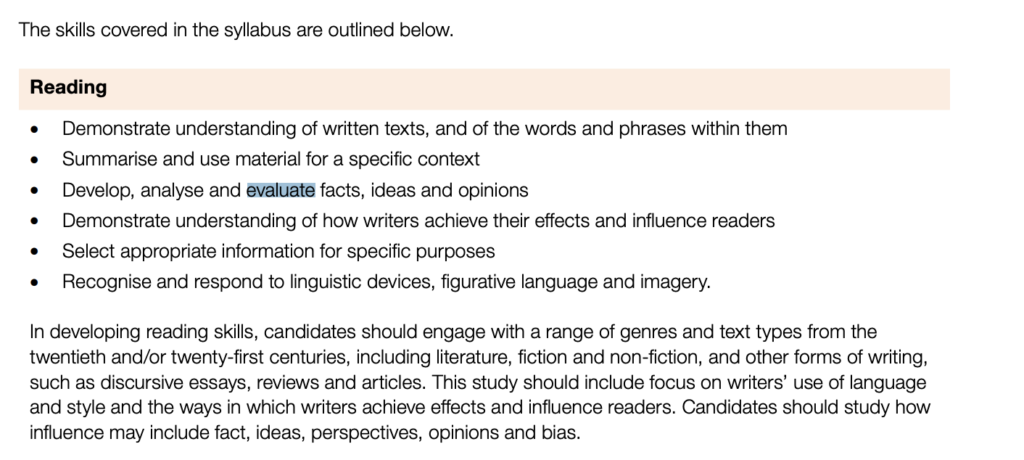
Evaluate.

It’s such an apparently simple word and appears in so many different places, yet it’s one that so many of my students have trouble with.

When they see it, they cringe – many of them don’t know what to do; rather than evaluate, they summarize.

But what does it actually mean to evaluate something?

To evaluate something means to assess it, to deepen your reasoning.

In the context of IGCSE First Language English, evaluation means showing the examiner that you can look at statements more deeply, thinking about the ways in which they are justified, and to either accept the statement or reject it based on the evidence and a sound reasoning process, before you write out your thoughts on paper.

For many students, however, this is both vague and foreign, because evaluate requires something more than just the ability to read content – it requires the ability to understand ideas, to synthesize them, and to logically reason with them.

If any of these steps is affected, a good evaluation cannot be produced.

Many students (and perhaps yourself) struggle with producing the kinds of evaluations that are necessary for the highest possible marks, partly because they lack experience in performing evaluations and partly because they don’t understand what to look for.

Sometimes, it is hard to fault them for this – after all, evaluation requires you to demonstrate something that’s not inside the text and to actually think about what it means – and how can you do this, if you’ve never spent any time in your life questioning the meaning of words or how to use them effectively?

This may sound vague for you, and it probably is…

But allow me to clarify.

Let me show you what an evaluation is not.

To do so, I’ll show you an example that one of my students recently wrote in response to Question 1 of Summer 2021, Variant 2.

Here is the insert:

Here’s the question text:

Question 1

Write a magazine article for young people about modern friendship.
In your article you should:

• evaluate the ideas about friendship given in both texts

• explain, based on what you read, to what extent you think social media affects friendship.

Base your article on what you have read in both texts, but be careful to use your own words.

Address both of the bullet points.

Write about 250 to 350 words.

…And lastly, here’s a paragraph written by one of my students below in response to the insert, and to the bullet point “evaluate the ideas about friendship given in both texts”:

The first article I read, “My best friendships happen online but that doesn’t make them any less valid”, discusses the topic of online friendships. In the article, the writer defends the idea of forming friendships on social media. The writer argues that social media allows one to connect, strengthen bonds with others and make new friends, allowing them to help fight the loneliness they feel. Furthermore, social media provides a place where anyone can freely express themselves, just like they would in real life. Additionally, social media is now an important tool for people who find social interaction challenging in real life. 

 On the other hand, the second article I read was “The limits of friendship”. In the article, research done by Robin Dunbar, an anthropologist, presented the importance of genuine friendship and that people who have a small social circle are more capable of maintaining a closer relationship with one another. Additionally, the article discusses the impact of social media on human interactions. It said that the interactions people receive on social media are not as meaningful as face-to-face interactions, because when individuals share an experience together, they can bond better in ways that social media does not allow. 

So, dear reader, what do you think the problem is here?

The student’s response provides a summary of the main ideas from both texts, but it does not fully evaluate the ideas about friendship presented in each text.

The response outlines the points made in the articles but does not go further to assess the strengths and weaknesses of each argument, consider alternative viewpoints, or discuss the implications of these ideas on modern friendship.

In other words, the student has missed the point of what was asked of them altogether and would not earn marks for this evaluation, because…

An evaluation is not a summary.

When you are asked to evaluate, you are not being asked to summarize. These are two completely different tasks.

Summarizing involves taking ideas directly from a text and then repeating them, perhaps in condensed form.

Evaluation entails making judgments – that you not only take in the words that you see in the text, but also contextualize them to your own situation and your own understanding; it entails that you process what is going on and reference it to your own understanding of things.

If you don’t do that… I’m sorry, you don’t have a choice. Either you do that, or you cannot do well.

I’m sure it does.

I’m sorry, but I don’t have a choice but to tell it to you as it is.

We’re not here to comfort you, to tell you that it’s okay when it’s not – that would be a disservice to you of the highest order, because no matter what, you need to improve.

So that said… Let’s evaluate the texts’ ideas about friendship together!

Let me first highlight the key points of what we are going to do in this next section, which will teach you how to evaluate.

How to Evaluate.

  1. Understand the text.

    You need to understand what is going on inside the text. If you don’t understand what’s going on, then you will have no recourse but to read it again and try to understand it.

    Read it and re-read it. Challenge your mind and your understanding of what’s going on – ask yourself questions about what you see, as you think about what is going on.

    For example, you can ask yourself – how are certain things in one part of the passage related to the rest? What do the pronouns refer to? Always reason, clarify, and verify that what you understand accords with what is going on inside the text by cross-checking.

  2. Logically reason with the content of the text.

    Once you have developed a good understanding of the content of a text, ask yourself how the different parts of the text fit together. Think for a moment – do you agree with the argument overall? Don’t decide yet, though – simply ask yourself the question in advance. Moving forward from there, you can proceed. Are there certain assumptions being made in the argument? Does the applicability of this argument only suit a limited context?

    These are all important questions that you will need to clarify.

  3. Synthesize the text in relation to what you are being asked to do.

    Each of the evaluations that you are going to do will be done in relation to a specific context – it won’t just occur in an isolated situation, but rather will be directly connected to specific questions that it’s going to be your duty to deal with.

    Are you supposed to give a speech or write an article, for example? If you are, then ask yourself: Who is your audience, what register would be suitable to them, and what would be valuable for your audience to hear?

Firstly, we must understand the text.

This means that you should read and re-read the text.

Ask yourself: What are they about?

Here’s a summary for those of you who have been following this.

Text A discusses the positive aspects of online friendships and argues that they are just as valid as face-to-face friendships. The author notes that the internet is often blamed for causing loneliness, low self-esteem, and social isolation, but also highlights how it has enabled many people to form meaningful relationships. The author shares personal experiences of their online friendships, stating that they can be authentic and substantial despite the lack of physical proximity. The text also acknowledges the role of technology and social media in connecting people who might otherwise struggle with in-person social interactions, such as introverts or people with disabilities.

Text B, on the other hand, focuses on the limits of friendship and how social media is changing the nature of human interaction. The text references anthropologist Robin Dunbar’s research, which suggests that humans can maintain a maximum of 150 social connections and that only five of these connections will be closest to us. Despite the increasing use of social media, Dunbar’s number of 150 has remained constant. The author argues that while social media allows us to keep track of more people, it lacks the shared experiences that strengthen face-to-face friendships. Additionally, the time spent on superficial online relationships may come at the expense of deeper, more meaningful connections.

Okay, now let’s respond to the question.

Question 1

Write a magazine article for young people about modern friendship.
In your article you should:

• evaluate the ideas about friendship given in both texts

• explain, based on what you read, to what extent you think social media affects friendship.

Base your article on what you have read in both texts, but be careful to use your own words.

Address both of the bullet points.

Write about 250 to 350 words.

To view this content, please sign up for a membership!

If you haven’t signed up yet, make sure to Join Now!
Already a member? Log in here

So, that’s my attempt – I don’t claim that it’s perfect, but I hope that it will give you a good start to things!

Let’s analyze what was done here. Throughout the writing process, I tried to…

  1. Compare and contrast the ideas presented in both texts: Instead of simply summarizing each article, I analyzed how the ideas about online friendships in Text A relate to the ideas about the limits of friendship in Text B, which helped the reader to recognize the complexities of modern friendships.

  2. Evaluate the strengths and weaknesses of each argument: I assessed the validity and relevance of the points made in each text, considering the evidence presented and any potential biases or limitations in the arguments. This is crucial for a good evaluation, because it involves reasoning through each argument and analyzing where the arguments make sense and do not, subjecting the arguments to one’s own experiences and thoughts.

  3. Consider alternative viewpoints: I tried to explore other perspectives on modern friendship that might not be covered in the texts. This could include discussing the role of technology in facilitating long-distance friendships, the impact of social media on mental health, and the potential for online friendships to transition into face-to-face relationships.

  4. Discuss the implications of the ideas presented: I tried to consider how the ideas about friendship in the texts might impact young people’s experiences and expectations of modern friendships and also discuss strategies for maintaining a healthy balance between online and offline relationships.

Once again, I won’t say that that’s perfect by any means, but as a teacher, express the hope that reading this and implementing the suggestions included managed to assist you in some way, shape, or form to achieve your goals.

There are many ways in which you can grow as a writer and as a thinker, and learning how to develop this skill is definitely one of those things 🙂

Good luck in your evaluation journey, and I will see you in the next post!

How To Write A Summary (Well!)

Victor Tan
 

One of the many things that First Language English asks you to do is to learn how to write a summary!

Seems obvious?

Well…

It isn’t, really.

See, when people hear ‘summary’, they immediately think that this means shortening an essay until it becomes something miniature – a compression of a long piece into something bite-sized… But is that what you need to do?

Let’s explore!

In the IGCSE First Language English exam, summary-writing is examined in question 1f).

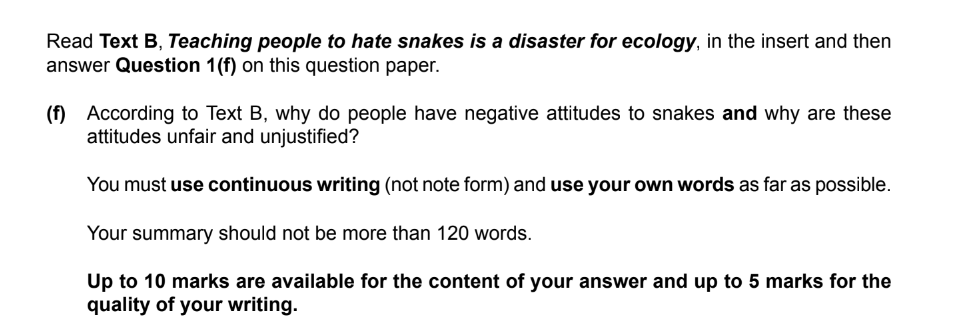
Here’s a text and an example question from Summer 2022, Paper 1, Variant 3, provided here for your consideration:

Alright! We can tell a few things about this:

  1. They’re not asking you to shorten the text.

    The text is titled “Teaching people to hate snakes is a disaster for ecology”, and the question is asking you “why do people have negative attitudes to snakes and why are these attitudes unfair and unjustified?”. You should be answering the question, not looking at every sentence and trying to find a ‘shorter’ way of writing it.
  2. They are asking you to find specific points in the text that answer the question.

    You are looking for points that answer the specific question that was being asked. “Humans often fear what they don’t understand” is a good point to note – we don’t need to know about the Zoo Chats or anything else in the third paragraph as that doesn’t answer the question.
  3. They are asking you to cut out irrelevant points.

    Not everything in the text is relevant – If I’m receiving a summary from someone titled “Why people have negative attitudes towards snakes and why these attitudes are unfair and unjustified”, I’m not going to care about when World Snake Day is or anything else.

To effectively write a summary for IGCSE First Language English and obtain the highest possible score in an exam, follow these steps:

  1. Read the task prompt:

    You have no idea how many summaries I have read in my lifetime that didn’t work because the student just went and tried to shorten the text. Please don’t do this – instead, please read the task prompt.

    No matter what, your summary needs to match the question, and you need to make sure that it addresses the essential points of the question.

    This is crucial, because you are not trying to shorten the entirety of the text – you are looking for the points that respond directly to the question, and hence you will have to select those points out.
  2. Read the passage carefully:

    Remember the task prompt, then thoroughly read the given passage to fully understand its content, context, and main ideas.
  3. Identify key points:

    As you read, make note of the main points and any supporting details in relation to the task prompt – i.e. since they’re asking “Why people have negative attitudes towards snakes and why these attitudes are unfair and unjustified”, look for parts of the text where you can find answers to those specific questions.

    Highlight them, then start thinking about how you can arrange or combine them into your summary.
  4. Organize your ideas:

    Once you’ve managed to decide which points belong in your summary, group the main points and supporting details in a logical order that supports the prompt. Note that often, this will cause you to end up with a chaotic list of things – so you need to start thinking about how you are going to combine the points with one another.
  5. Paraphrase:

    By this point, you have a list of points highlighted on the insert – now, you have to think about how to combine them into concise sentences that capture what you need.

    Note that often, less is more.
  6. Keep it concise:

    A summary should be brief and to the point.

    Aim to include only the most important information, and avoid any unnecessary details, examples, or personal opinions.

    When in doubt, look at any part of your summary and ask:

    “Does this answer the question?”
  7. Use appropriate language:

    Avoid slang, contractions, and colloquialisms.
  8. Review the task prompt:

    As you write your summary, continually refer back to the task prompt to ensure you’re addressing all requirements. This will help you stay focused and avoid straying from the task at hand.
  9. Edit and proofread:

    Once you’ve written your summary, take the time to carefully review and edit it. Look for any errors in grammar, punctuation, or spelling, and correct them as needed.

    Oh wait, what’s that? The last tip?
  10. Practice:

    This is probably common sense, but in case it’s not… Practice!

    Showing up makes a difference even if you don’t notice that it’s happening – let yourself have the time and space to process things in your mind, and keep doing it even if you don’t immediately see the results; that’s how you give yourself the opportunity to grow and get better at this, one step at a time.

    Scheduling a good time for yourself or even using ChatGPT to remind yourself can be helpful, and so is doing the summary task under timed conditions – it might be hard at first to finish in the given time and you may overshoot, but trust your brain and its ability to learn: That’s why we’re here, and that’s something that is perfectly in your capacity.

And that’s it for now!

We hope you enjoyed this piece – enjoy, and have a wonderful one ahead!

V.

Writer’s Effect Analysis of Martin Luther King Jr.’s “I Have A Dream”

Victor Tan
 

Today, I thought to accomplish two separate goals:

Firstly, I’d like to introduce a series that showcases examples of incredible rhetoric throughout human history so that all of you on the site can appreciate it.

Second of all, I’d like to begin having us look at examples of how the tools that we’ve discussed in our Writer’s Effect guide can be used to analyze and break down texts, by example and also by reference, to allow you to break past theory into practice.

How we will start.

I’d like to start this series by talking about one of the most famous speeches of all time:

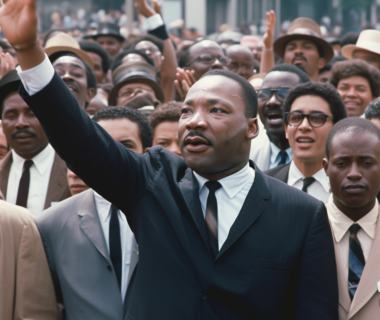
Martin Luther King Jr.’s “I Have A Dream” speech.

Delivered by Martin Luther King Jr. on August 28, 1963, during the March on Washington for Jobs and Freedom, the speech is significant for several reasons:

  1. Raising awareness of racial inequality: The speech brought the issue of racial inequality and the civil rights movement to the forefront of American consciousness, raising awareness about the injustices faced by African Americans and the need for change.
  2. Inspiring hope and change: King’s message of hope and his vision of a future where all people are equal inspired countless individuals to join the struggle for civil rights, sparking a nationwide movement for change.
  3. Demonstrating the power of nonviolence: The speech and the March on Washington showcased the effectiveness of nonviolent protest as a means of achieving social and political change, influencing future generations of activists and social justice movements.
  4. Impact on legislation: The speech and the broader civil rights movement played a crucial role in the passage of landmark legislation, such as the Civil Rights Act of 1964 and the Voting Rights Act of 1965, which aimed to dismantle racial segregation and discrimination in the United States.

We could go into the history of King and what he did for a long while, but let’s not do that, because we’re here primarily to talk about language.

What we will do.

  1. Read.
    • In this post, you will find the full text of King’s epic speech. Please feel free to read it.
    • Please recall how to find things on both Windows or Mac; you will need to hit “CTRL + F” or “CMD + F” in order to navigate this post.
  2. Guide you.
    • We will provide you with helpful phrases that you can use for your writer’s effect analyses.
    • We will justify each usage of a phrase within the context of an essay, relating this to the way that the phrases can be used to draw out the effect of the words that have been used in the speech.

As a note, these are not a perfect analogue to what you will encounter in the actually exam, whereby you have to seek out three specific phrases in a text and then write your piece. Moreover the phrases will not exactly be used verbatim – still, each of the phrases should give you a good idea about how to proceed.

Concerning the number of examples:

There are two for non-members as a preview, three more for those of you who sign up for a free membership, and 20+ for our premium members.

Sounds good? Let’s go!

Here’s the text of the speech.

“I am happy to join with you today in what will go down in history as the greatest demonstration for freedom in the history of our nation.

Five score years ago, a great American, in whose symbolic shadow we stand today, signed the Emancipation Proclamation. This momentous decree came as a great beacon light of hope to millions of Negro slaves who had been seared in the flames of withering injustice. It came as a joyous daybreak to end the long night of their captivity.

But one hundred years later, the Negro still is not free. One hundred years later, the life of the Negro is still sadly crippled by the manacles of segregation and the chains of discrimination. One hundred years later, the Negro lives on a lonely island of poverty in the midst of a vast ocean of material prosperity. One hundred years later, the Negro is still languished in the corners of American society and finds himself an exile in his own land. And so we’ve come here today to dramatize a shameful condition.

In a sense we’ve come to our nation’s capital to cash a check. When the architects of our republic wrote the magnificent words of the Constitution and the Declaration of Independence, they were signing a promissory note to which every American was to fall heir. This note was a promise that all men, yes, black men as well as white men, would be guaranteed the “unalienable Rights” of “Life, Liberty and the pursuit of Happiness.” It is obvious today that America has defaulted on this promissory note, insofar as her citizens of color are concerned. Instead of honoring this sacred obligation, America has given the Negro people a bad check, a check which has come back marked “insufficient funds.”

But we refuse to believe that the bank of justice is bankrupt. We refuse to believe that there are insufficient funds in the great vaults of opportunity of this nation. And so, we’ve come to cash this check, a check that will give us upon demand the riches of freedom and the security of justice.

We have also come to this hallowed spot to remind America of the fierce urgency of Now. This is no time to engage in the luxury of cooling off or to take the tranquilizing drug of gradualism. Now is the time to make real the promises of democracy. Now is the time to rise from the dark and desolate valley of segregation to the sunlit path of racial justice. Now is the time to lift our nation from the quicksands of racial injustice to the solid rock of brotherhood. Now is the time to make justice a reality for all of God’s children.

It would be fatal for the nation to overlook the urgency of the moment. This sweltering summer of the Negro’s legitimate discontent will not pass until there is an invigorating autumn of freedom and equality. Nineteen sixty-three is not an end, but a beginning. And those who hope that the Negro needed to blow off steam and will now be content will have a rude awakening if the nation returns to business as usual. And there will be neither rest nor tranquility in America until the Negro is granted his citizenship rights. The whirlwinds of revolt will continue to shake the foundations of our nation until the bright day of justice emerges.

But there is something that I must say to my people, who stand on the warm threshold which leads into the palace of justice: In the process of gaining our rightful place, we must not be guilty of wrongful deeds. Let us not seek to satisfy our thirst for freedom by drinking from the cup of bitterness and hatred. We must forever conduct our struggle on the high plane of dignity and discipline. We must not allow our creative protest to degenerate into physical violence. Again and again, we must rise to the majestic heights of meeting physical force with soul force.

The marvelous new militancy which has engulfed the Negro community must not lead us to a distrust of all white people, for many of our white brothers, as evidenced by their presence here today, have come to realize that their destiny is tied up with our destiny. And they have come to realize that their freedom is inextricably bound to our freedom.

We cannot walk alone.

And as we walk, we must make the pledge that we shall always march ahead.

We cannot turn back.

There are those who are asking the devotees of civil rights, “When will you be satisfied?” We can never be satisfied as long as the Negro is the victim of the unspeakable horrors of police brutality. We can never be satisfied as long as our bodies, heavy with the fatigue of travel, cannot gain lodging in the motels of the highways and the hotels of the cities. **We cannot be satisfied as long as the negro’s basic mobility is from a smaller ghetto to a larger one. We can never be satisfied as long as our children are stripped of their self-hood and robbed of their dignity by signs stating: “For Whites Only.”** We cannot be satisfied as long as a Negro in Mississippi cannot vote and a Negro in New York believes he has nothing for which to vote. No, no, we are not satisfied, and we will not be satisfied until “justice rolls down like waters, and righteousness like a mighty stream.”

I am not unmindful that some of you have come here out of great trials and tribulations. Some of you have come fresh from narrow jail cells. And some of you have come from areas where your quest — quest for freedom left you battered by the storms of persecution and staggered by the winds of police brutality. You have been the veterans of creative suffering. Continue to work with the faith that unearned suffering is redemptive. Go back to Mississippi, go back to Alabama, go back to South Carolina, go back to Georgia, go back to Louisiana, go back to the slums and ghettos of our northern cities, knowing that somehow this situation can and will be changed.

Let us not wallow in the valley of despair, I say to you today, my friends.

And so even though we face the difficulties of today and tomorrow, I still have a dream. It is a dream deeply rooted in the American dream.

I have a dream that one day this nation will rise up and live out the true meaning of its creed: “We hold these truths to be self-evident, that all men are created equal.”

I have a dream that one day on the red hills of Georgia, the sons of former slaves and the sons of former slave owners will be able to sit down together at the table of brotherhood.

I have a dream that one day even the state of Mississippi, a state sweltering with the heat of injustice, sweltering with the heat of oppression, will be transformed into an oasis of freedom and justice.

I have a dream that my four little children will one day live in a nation where they will not be judged by the color of their skin but by the content of their character.

I have a dream today!

I have a dream that one day, down in Alabama, with its vicious racists, with its governor having his lips dripping with the words of “interposition” and “nullification” — one day right there in Alabama little black boys and black girls will be able to join hands with little white boys and white girls as sisters and brothers.

I have a dream today!

I have a dream that one day every valley shall be exalted, and every hill and mountain shall be made low, the rough places will be made plain, and the crooked places will be made straight; “and the glory of the Lord shall be revealed and all flesh shall see it together.”2

This is our hope, and this is the faith that I go back to the South with.

With this faith, we will be able to hew out of the mountain of despair a stone of hope. With this faith, we will be able to transform the jangling discords of our nation into a beautiful symphony of brotherhood. With this faith, we will be able to work together, to pray together, to struggle together, to go to jail together, to stand up for freedom together, knowing that we will be free one day.

And this will be the day — this will be the day when all of God’s children will be able to sing with new meaning:

My country ’tis of thee, sweet land of liberty, of thee I sing. Land where my fathers died, land of the Pilgrim’s pride,    From every mountainside, let freedom ring!

And if America is to be a great nation, this must become true.

And so let freedom ring from the prodigious hilltops of New Hampshire.

Let freedom ring from the mighty mountains of New York.

Let freedom ring from the heightening Alleghenies of Pennsylvania.

Let freedom ring from the snow-capped Rockies of Colorado.

Let freedom ring from the curvaceous slopes of California.

But not only that:

Let freedom ring from Stone Mountain of Georgia.

Let freedom ring from Lookout Mountain of Tennessee.

Let freedom ring from every hill and molehill of Mississippi.

From every mountainside, let freedom ring.

And when this happens, and when we allow freedom ring, when we let it ring from every village and every hamlet, from every state and every city, we will be able to speed up that day when all of God’s children, black men and white men, Jews and Gentiles, Protestants and Catholics, will be able to join hands and sing in the words of the old Negro spiritual:

Free at last! Free at last!

Thank God Almighty, we are free at last!3

With that said, let’s proceed with our analysis and suggest numerous helpful phrases that you can use as part of your writer’s effect analyses. The first two are provided for free to non-members, and to view the next three, you will need a membership. The remainder will be accessible only to our premium members.

Phrase 1:
“Utilizing parallelism to emphasize a point,”
Justification: In Martin Luther King’s “I Have a Dream” speech, the use of parallelism is evident when he repeats the phrase “I have a dream” throughout the speech. By repeating this phrase, King drives home the importance of his vision for a racially equal America. The repetition of “I have a dream” creates a rhythmic pattern that makes the speech memorable and engaging, thus inspiring the audience to take action for social change.

Phrase 2:
“Employing anaphora to create a sense of unity,”
Justification: Anaphora, the repetition of words or phrases at the beginning of successive lines, is used by King in “I Have a Dream” to emphasize the collective nature of his message. For example, he repeats “one hundred years later” several times to convey the ongoing struggle for civil rights. This repetition unifies the ideas in his speech, creating a cohesive message that resonates with the audience and emphasizes the need for solidarity in the fight for equality.

The following points are for our premium members.

If you would like access to grow your ideas and thoughts, consider picking up a premium membership today!

To view this content, please sign up for a membership!

If you haven’t signed up yet, make sure to Join Now!
Already a member? Log in here