

The Task Lens, RICE test and complete selection process I use for Cambridge IGCSE 0500 Paper 1 Question 2(a).
Syllabus note: This guide follows the Cambridge IGCSE First Language English 0500 format for examinations in 2027, 2028 and 2029. In this format, summary writing appears in Paper 1, Question 2(a).
Welcome back, all!
A summary is not a passage that has been put through a shrink ray.
It is a selection exercise.
That distinction matters because most students do not lose summary marks when they begin shortening sentences. They lose them earlier—when deciding what the passage is actually saying.
By the time the paraphrasing begins, the wrong ideas may already have been chosen.
You can shorten a text beautifully and still produce a weak summary if you have shortened the wrong material. Equally, you can identify many true statements from the passage and receive limited credit if those statements do not answer the precise question.
The hardest part of summary writing happens before you write the summary.
This is how I approach it.
First, what does the 2027–29 summary require?
Paper 1 Question 2(a) is based on Text B and is worth 15 marks:
- 10 Reading marks
- 5 Writing marks
Candidates must:
- Answer the precise summary focus
- Write in continuous prose rather than notes
- Use their own words as far as possible
- Remain within 120 words
The official 2027 specimen Paper 1 and its mark scheme confirm these requirements.
For Reading, the highest levels reward:
- Understanding of a wide range of relevant ideas
- Consistent focus on the text and task
- Skilful selection
- Evidence of an overview
For Writing, they reward:
- Clear and fluent expression
- Effective organisation
- Concise and appropriate vocabulary
Notice how often the criteria return to selection.
Not shortening. Not synonym replacement. Selection.
An important myth: ten points do not automatically equal ten marks
Students often imagine the summary as a simple exchange:
Find ten points. Receive ten Reading marks.
That is not how the 2027 task is marked.
Cambridge uses a holistic level table. The official specimen mark scheme lists 12 possible relevant ideas even though only 10 Reading marks are available.
This gives candidates room to select. It does not create a one-point-for-one-mark transaction.
Ten statements will not automatically earn ten marks if they are repetitive, vague, irrelevant or indiscriminately chosen. Equally, the top-band criteria do not prescribe one compulsory number of points.
Finding every possible idea is a planning skill.
Choosing the strongest combination is the examination skill.
Throughout this article, I will use “creditworthy point” as a practical term for a relevant idea. It does not mean that each point is guaranteed one mark.
What is a creditworthy summary point?
A creditworthy point is not simply a sentence that looks important.
It is a distinct idea that:
- Answers the exact summary question
- Is supported explicitly or implicitly by the passage
- Adds something meaningfully different from your other points
- Is complete and precise enough to communicate independently
- Contributes to an overview of the text’s answer
A sentence can contain several separate points.
Several sentences can also repeat one underlying point.
Point boundaries are determined by meaning, not punctuation.
My complete point-finding method
Final point-finding checklist
Before writing:
- I have reduced the question to a clear Task Lens.
- I have checked every paragraph.
- Every candidate idea answers the exact focus.
- Each idea is supported by the passage.
- I have separated distinct ideas.
- I have merged repetition and non-essential examples.
- I have covered every part of the question.
- I have grouped related ideas to create an overview.
After writing:
- My response is continuous prose.
- I have used my own words as far as possible.
- Every sentence carries useful information.
- I have not added commentary.
- I have not repeated an idea.
- My expression is clear and concise.
- My summary remains within 120 words.
The summary task becomes much easier when you stop trying to write and select at the same time.
Find first.
Test second.
Group third.
Write last.
If you would benefit from complete model responses and another layer of feedback on your own work, you can explore EnglishFirstLanguage.net Premium membership and learn more about the IGCSE Essay Marker.
The goal is not to memorise somebody else’s summary.
It is to make your own selection process visible, deliberate and repeatable.
All the best!
V.
Official Cambridge sources
Paper 1, Paper 2, coursework, word counts and every important change explained.
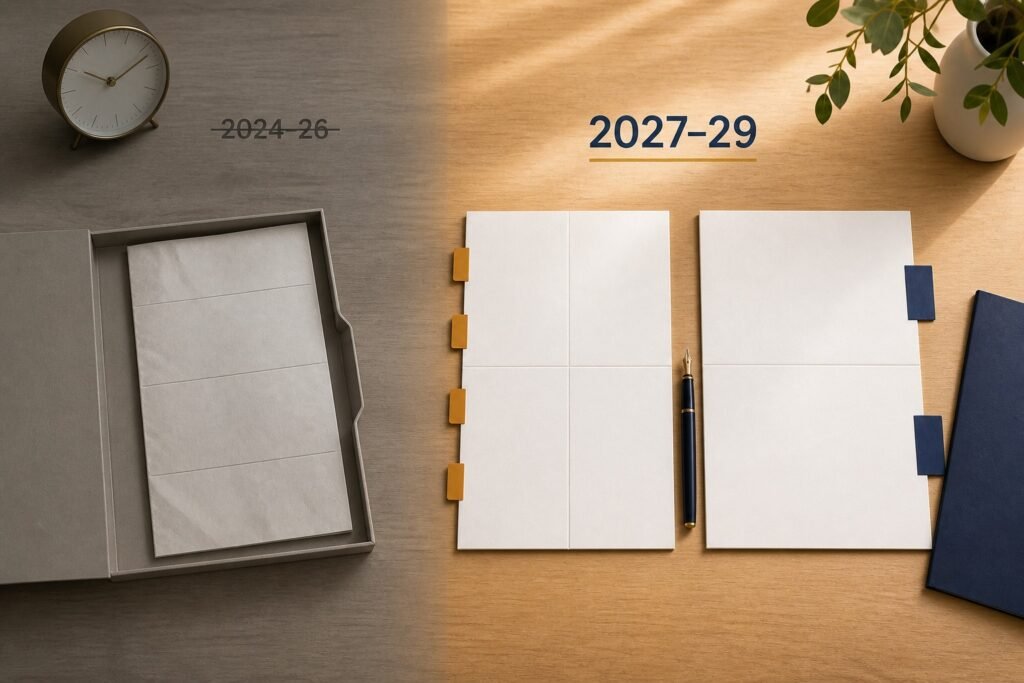
This guide applies to examinations taken in 2027, 2028 and 2029.
Sitting the examination in 2026? Do not use this structure. You are still following the 2024–26 syllabus. Also, if you are currently following the 2024 to 2026 syllabus, the exams in October are your final exams. Good luck with them!
Welcome back, all!
A syllabus change is a little like somebody moving the furniture in a familiar room.
The furniture itself is still recognisable. Summary writing is still summary writing. Writer’s Effect is still Writer’s Effect. Extended Response to Reading has not mysteriously vanished.
But if you attempt to navigate using the old map, you may walk into things.
From 2027, Cambridge IGCSE First Language English 0500 retains its familiar two-hour, 80-mark papers. However, several questions have moved, some mark allocations have changed and Paper 1 now has a noticeably tidier structure.
Four questions. Twenty marks each.
Simple?
Well… broadly. But those four sets of 20 marks do not all assess the same skills. Let’s look at exactly where every mark lives.
The 30-second answer
Every candidate takes Paper 1 and either Paper 2 or Component 3 Coursework.
| Component | Duration | Marks | Weighting |
|---|---|---|---|
| Paper 1: Reading | 2 hours | 80 | 50% |
| Paper 2: Directed Writing and Composition | 2 hours | 80 | 50% |
| Component 3: Coursework Portfolio | Completed during the course | 80 | 50% |
| Component 4: Speaking and Listening | Approximately 10–12 minutes | 40 | Separately endorsed |
Component 3 is an alternative to Paper 2. Component 4 is optional and does not contribute to the main A*–G grade.
Across the Paper 1 and Paper 2 route, there are exactly:
- 80 Reading marks
- 80 Writing marks
Paper 1 carries 65 Reading marks and 15 Writing marks. Paper 2 reverses the balance, carrying 15 Reading marks and 65 Writing marks.
The overall qualification is therefore more balanced than either individual paper might initially suggest.
The full structure is confirmed in Cambridge’s official 2027–29 syllabus.
Paper 1: Reading
Duration: 2 hours
Total: 80 marks
Weighting: 50%
Texts: Three texts, totalling approximately 1400 words
Questions: Four compulsory questions worth 20 marks each
Dictionary: Not permitted
Cambridge recommends spending approximately 15 minutes reading. It does not prescribe a fixed amount of time for each question.
The equal 20-mark structure makes 30 minutes per question an appealing starting point, but remember that equal marks do not necessarily mean equal reading or writing time. Test your timing under examination conditions before deciding what works for you.
Paper 1 at a glance
| Task | Source | Marks | Word guidance |
| Question 1: Comprehension | Text A | 20 Reading | No set length |
| Question 2(a): Summary | Text B | 10 Reading + 5 Writing | No more than 120 words |
| Question 2(b): Attitude or opinion | Text B | 5 Reading | No set length |
| Question 3: Short answers | Text C | 10 Reading | Varies |
| Question 3: Language analysis | Text C | 10 Reading | About 200–250 words |
| Question 4: Extended Response | Text C | 10 Reading + 10 Writing | About 250–300 words |
Question 1: Comprehension — 20 marks
Question 1 consists of several structured comprehension questions based on Text A.
This is not simply a collection of fact-retrieval questions. Cambridge states that Question 1 can test all five Reading assessment objectives, including:
- Explicit meaning
- Implicit meaning and attitudes
- Analysis and evaluation
- How writers create effects
- Selection of information for a particular purpose
The exact number and arrangement of sub-questions may vary. However, the official 2027 specimen Paper 1 uses this structure:
| Specimen question | What the candidate does | Marks |
| 1(a) | Retrieves one specific detail | 1 |
| 1(b)(i) | Explains a phrase in their own words | 2 |
| 1(b)(ii) | Explains another phrase in their own words | 2 |
| 1(c) | Gives two explicit details | 2 |
| 1(d) | Identifies two implied reasons | 2 |
| 1(e)(i) | Explains an evidence-based conclusion | 3 |
| 1(e)(ii) | Explains why that conclusion later changed | 3 |
| 1(f)(i) | Explains the effect of one word choice | 2 |
| 1(f)(ii) | Explains what a figurative phrase suggests | 3 |
| Total | 20 |
This table shows the specimen-paper pattern—not a guarantee that every live paper will use precisely the same subparts.
Here’s the danger: because Question 1 is called “comprehension”, students may assume that every answer can simply be lifted from the text.
It cannot.
Some questions require selection. Some require your own words. Others ask you to explain implications or analyse why the writer chose one expression rather than another.
Read the command word carefully.
Question 2: Summary and attitude — 20 marks
Question 2 is based on Text B and contains two distinct tasks.
Question 2(a): Selective summary — 15 marks
The summary is worth:
- 10 Reading marks
- 5 Writing marks
Candidates must:
- Select ideas relevant to the precise summary focus
- Write in continuous prose rather than note form
- Use their own words as far as possible
- Remain within 120 words
The summary has not disappeared. It has moved from Question 1(f) in the old format to Question 2(a).
The Reading marks reward understanding, focus and intelligent selection. The Writing marks reward clarity, organisation and concision.
Notice that this is not a miniature essay. You do not need a grand introduction, a rhetorical opening or a concluding flourish. Every word must earn its place.
The core summary skills remain the same, so you can still use How to Write a Summary Well. Just remember that older resources may display the previous question number.
Question 2(b): Attitude or opinion response — 5 marks
This is a new, separate five-mark question.
Candidates respond to an aspect of the writer’s attitude or opinion and support their answer using details from Text B.
In the specimen paper, candidates are asked to assess the writer’s attitude and use three textual details. The exact wording may vary, but the underlying task involves:
- Recognising the writer’s position
- Explaining how that position is conveyed
- Supporting the interpretation with relevant evidence
There is no stated word count.
Do not treat this as another summary. You are not simply collecting what the writer says; you are explaining what the writer appears to think or feel.
The skill overlaps with evaluation in IGCSE First Language English, although you should use the 2027 specimen paper for the new task structure.
Question 3: Short answers and language analysis — 20 marks
Question 3 is based on Text C.
It contains:
- 10 marks of short-answer work
- 10 marks for the main language-analysis task
The short-answer section — 10 marks
In the specimen paper, the first 10 marks are distributed as follows:
| Specimen question | What the candidate does | Marks |
| 3(a)(i) | Finds a word or phrase matching a stated idea | 1 |
| 3(a)(ii) | Finds another matching word or phrase | 1 |
| 3(b)(i)–(iii) | Explains three words in their own words | 3 |
| 3(c) | Selects one example and explains its language effect | 5 |
| Subtotal | 10 |
Question 3(c) acts as a useful bridge: instead of analysing several choices, you explain one example carefully and precisely.
Again, Cambridge fixes the overall task types and the 10-plus-10 division. The exact specimen subparts should not be treated as a promise about every future paper.
The main language task — 10 marks
The larger language-analysis response is worth 10 Reading marks.
Candidates write approximately 200–250 words.
In the specimen, candidates choose three powerful words or phrases from one extract and analyse how the writer uses them. Future questions may vary in wording, so always follow the live paper’s instructions.
A strong response should:
- Select precise and productive words or phrases
- Explain their meaning in context
- Explore associations, connotations and imagery
- Explain why the writer’s particular choice is effective
- Connect the language to the wider portrayal or atmosphere
Simply identifying a metaphor is not analysis.
Neither is saying that a phrase “makes the reader want to read on”.
The familiar Writer’s Effect skill remains. Its new home is Question 3 rather than the old Question 2(d), and the main task is now worth 10 marks rather than 15.
You can revisit the underlying analytical method in Writer’s Effect: A Deep Dive into the Marking Criteria, while using the new specimen paper for the current structure and mark allocation.
Question 4: Extended Response to Reading — 20 marks
Question 4 is also based on Text C.
Candidates write approximately 250–300 words.
The 20 marks are divided equally:
- 10 Reading marks
- 10 Writing marks
Candidates may be asked to write a:
- Letter
- Report
- Journal
- Speech
- Interview
- Article
The task requires candidates to adopt a specified role, viewpoint, audience and purpose while selecting and developing ideas from Text C.
The Reading marks reward:
- Understanding of explicit and implicit ideas
- Selection of relevant material
- Analysis, evaluation and development
- Supporting detail from the text
- Coverage of every part of the task
The Writing marks reward:
- Effective style
- Deliberate organisation
- Precise vocabulary
- An appropriate and convincing voice
- Language suited to audience and purpose
In the specimen, Question 4 is presented as an interview consisting of three questions. That is one possible scenario—not a prediction of what future papers will contain.
This task used to be Question 3 and was worth 25 marks. From 2027, it becomes Question 4, worth 20 marks, with a shorter suggested response length.
For a reminder of how the possible forms differ, see the complete breakdown of 0500 text types.
Paper 2: Directed Writing and Composition
Duration: 2 hours
Total: 80 marks
Weighting: 50%
Answers required: Question 1 and one composition
Dictionary: Not permitted
Paper 2 still contains two 40-mark sections. However, Section A now begins with a new five-mark reading question.
Paper 2 at a glance
| Task | Marks | Word guidance |
| Question 1(a): Structured reading response | 5 Reading | No set length |
| Question 1(b): Directed Writing | 10 Reading + 25 Writing | About 250–350 words |
| One composition from Questions 2–5 | 40 Writing | About 350–450 words |
Section A: Directed Writing — 40 marks
The task is based on one or two texts totalling 550–650 words. This has been reduced from 650–750 words in the previous format.
Question 1(a): Structured reading response — 5 marks
Question 1(a) is new.
It is a short, separate task requiring candidates to analyse, evaluate and demonstrate their understanding of the source material.
In the specimen, candidates evaluate a person’s attitude to work using their own words and supporting details from an extract.
This is not merely planning space for Question 1(b). It is an assessed response worth five Reading marks.
To reach the highest level, candidates need to demonstrate a clear understanding of the attitude or idea being examined and support that interpretation with relevant textual detail.
Question 1(b): Directed Writing — 35 marks
Question 1(b) is the main Directed Writing response.
It is worth:
- 10 Reading marks
- 25 Writing marks
Candidates write approximately 250–350 words.
They use, develop and evaluate ideas from the supplied text or texts to produce a discursive, argumentative or persuasive:
- Speech
- Letter
- Article
- Report
The addition of the report is worth noticing. Under the preceding syllabus, the listed Paper 2 forms were speech, letter and article.
The Reading marks reward the range, development and integration of source ideas. The Writing marks reward style, structure, vocabulary, audience awareness and accuracy.
A high-level response does not march mechanically through Text A and then Text B. It reorganises and synthesises ideas to create a convincing independent response.
In other words, the sources provide your material—but they should not dictate your paragraph order.
Section B: Composition — 40 marks
Candidates choose one of four titles:
- Question 2: descriptive writing
- Question 3: descriptive writing
- Question 4: narrative writing
- Question 5: narrative writing
You answer one of them.
The suggested length is approximately 350–450 words.
Every composition is marked using the same division:
- 16 marks for Content and Structure
- 24 marks for Style and Accuracy
That means 60 per cent of the composition marks are attached to style and accuracy.
For descriptive writing, the highest levels reward:
- A convincing overall picture
- Carefully developed images and details
- Close observation
- Varied focus
- Deliberate structure
- Effective figurative language
For narrative writing, they reward:
- A developed and engaging plot
- Convincing detail
- Characterisation
- Description
- Structural control
- An effective climax
For both forms, vocabulary, sentence control, spelling, punctuation and grammar matter enormously.
The composition section has not been substantially restructured for 2027. The four choices, 40 marks, 350–450-word guidance and 16/24 division remain.
If composition is your weaker area, revisit Should You Plan Your Essays?, alongside the narrative composition bank and descriptive writing guide.
What changed from the 2024–26 format?
Here is the simplest side-by-side comparison:
| Area | 2024–26 | 2027–29 |
| Paper 1 structure | Three numbered questions: 30, 25 and 25 marks | Four questions worth 20 marks each |
| Text A comprehension | 15 marks | 20 marks |
| Summary | Question 1(f), 15 marks | Question 2(a), 15 marks |
| Separate attitude task | None | New Question 2(b), 5 marks |
| Main language analysis | Question 2(d), 15 marks, about 200–300 words | Question 3, 10 marks, about 200–250 words |
| Extended Response | Question 3, 25 marks, about 250–350 words | Question 4, 20 marks, about 250–300 words |
| Paper 2 source material | 650–750 words | 550–650 words |
| Directed Writing | One 40-mark response | Question 1(a), 5 marks; Question 1(b), 35 marks |
| Paper 2 forms | Speech, letter or article | Speech, letter, article or report |
| Composition | 40 marks | Structurally unchanged |
| Marking criteria | 2024–26 criteria | Updated criteria |
Cambridge explains that the wording of the assessment objectives has changed, but the knowledge and skills being assessed have not.
This is why older papers are not useless. The skills remain highly transferable. However, older papers no longer provide an accurate simulation of the question order, mark allocation or suggested response lengths.
The word counts: which one is actually a maximum?
This distinction matters.
| Task | Cambridge’s wording |
| Paper 1 Question 2(a), summary | No more than 120 words |
| Paper 1 language analysis | About 200–250 words |
| Paper 1 Extended Response | About 250–300 words |
| Paper 2 Directed Writing | About 250–350 words |
| Paper 2 composition | About 350–450 words |
The summary has an explicit maximum.
The other figures are guidance. Cambridge does not apply an automatic fixed penalty simply because a response is slightly above or below a suggested length. However, an extremely short response may lack development, while an excessively long response may lose focus, waste time or accumulate errors.
The safest approach? Treat 120 words as the operational maximum for the summary and use the other ranges as sensible targets.
Cambridge explains its approach further in its official word-count guidance.
Does every candidate take Paper 2?
No.
Every candidate takes Paper 1 and then takes either:
- Paper 2, or
- Component 3 Coursework
Component 3: Coursework Portfolio
The coursework portfolio contains three assignments of approximately 500–800 words each:
| Assignment | Task | Marks |
| Assignment 1 | Discuss, argue or persuade in response to one or more texts | 15 Reading + 15 Writing |
| Assignment 2 | Descriptive writing | 25 Writing |
| Assignment 3 | Narrative writing | 25 Writing |
| Total | 80 |
The portfolio is internally assessed and externally moderated.
Component 4: Speaking and Listening
Component 4 is optional and separately endorsed. Its marks do not affect the main 0500 grade.
It consists of:
- An Individual Talk of approximately 3–4 minutes—20 marks
- A Conversation of approximately 7–8 minutes—20 marks
The full test therefore lasts approximately 10–12 minutes.
Can I still use pre-2027 past papers?
Yes—but use them intelligently.
Older papers remain useful for isolated practice in:
- Summary writing
- Language analysis
- Extended Response to Reading
- Directed Writing
- Descriptive composition
- Narrative composition
They should not be used as exact 2027-format mock examinations.
For a full timed simulation, use the official 2027 specimen papers. For targeted practice, older tasks can still be extremely valuable.
The key is to separate skill practice from format practice.
Frequently asked questions
When does the new 0500 format begin?
It begins with examinations taken in 2027 and remains in place for 2028 and 2029.
Candidates sitting in 2026 must use the 2024–26 format.
How many questions are on Paper 1?
There are four compulsory questions, each worth 20 marks.
Is the summary still assessed?
Yes. It is now Question 2(a), worth 15 marks, with a maximum of 120 words.
Is Writer’s Effect still assessed?
Yes. The main language-analysis task now appears in Question 3 and is worth 10 marks. The suggested length is approximately 200–250 words.
What is the new Paper 2 Question 1(a)?
It is a separate five-mark reading question requiring analysis, evaluation and supported understanding of the source material.
How are the composition marks divided?
There are 16 marks for Content and Structure and 24 marks for Style and Accuracy.
Are dictionaries permitted?
No. Dictionaries are not permitted in Paper 1 or Paper 2.
Does the specimen predict the real examination topics?
No. The specimen demonstrates the structure, wording style and marking approach. Its subject matter is not a prediction.
What should I do next?
Knowing the map matters. But knowing where the marks are located is not the same as knowing how to earn them.
A sensible next step is:
- Read the relevant question.
- Study one strong worked response.
- Attempt a parallel task yourself.
- Mark it or obtain feedback.
- Rewrite the weakest part.
- Attempt another task to test whether the improvement transferred.
If you would like complete model-response banks and a more structured feedback loop, you can explore EnglishFirstLanguage.net Premium membership and learn about the IGCSE Essay Marker.
The new format is different. It is not, however, an entirely new language.
The same fundamental abilities remain: read precisely, infer intelligently, analyse language, develop ideas and write with control.
Now you know where every mark lives.
The next step is learning what a strong response does with those marks.
All the best!
V.
Official Cambridge materials
Welcome back, all! English has a wonderful paradox tucked inside it: the phrase “a deafening silence”. Silence is the absence of sound, and yet we describe it as if it could be loud enough to hurt. That’s because we never really experience silence on its own — we only notice it as the sudden absence of a noise we had stopped hearing. Silence is defined entirely by what it interrupts.
That’s the secret to writing it well. You cannot describe quiet directly; you describe the sounds that stop, and the tiny sounds that grow brave in the gap — a dripping tap, a ticking clock, your own heartbeat. Silence, in good prose, is loud precisely because it is surrounded by things that have just fallen still.
This week’s essay prompt: “Write a story that includes the words ‘… everything went quiet …’.” — Question 4 from the October/November 2025 Paper 2 series.
Here’s the craft challenge: the required words mark a moment of rupture — the instant before or after something terrible or decisive. Weak responses bury the phrase in the middle of ordinary action. The strongest ones make that sudden quiet the pivot of the whole opening, and start in medias res, dropping us straight into the crisis.
A sophisticated writer will let the theme of sound and silence run all the way through — the quiet that rushes in at the start returning, transformed, at the very end. That kind of patterning turns a required phrase into the emotional spine of the piece.
The full essay is available for our premium members and is also marked and graded according to the IGCSE First Language English official rubrics and marking criteria. By reading it, you can see how a top-band narrative opens on breaking ice and a sudden, roaring silence — and how the horror of indifferent nature can be made more chilling than any villain.
And if you want to know how your own writing measures up, our IGCSE Essay Marker gives you instant, rubric-aligned feedback on your own descriptive and narrative compositions in seconds.
If you haven’t signed up already, then make sure to sign up over here!

Welcome back, all!
Naming a technique is rather like identifying a tool on a workbench.
“That is a hammer.”
Correct.
But what did it build? What did it break? Why was that tool chosen instead of another?
We still know none of these things.
The same problem appears constantly in Writer’s Effect responses:
The writer uses personification in “the train swallowed them”.
Perfectly accurate.
Also incomplete.
Many students approach Writer’s Effect as though the examination were a linguistic scavenger hunt.
Metaphor spotted.
Personification captured.
Alliteration discovered.
Three techniques collected. Surely the marks must now arrive?
Unfortunately, Cambridge is not primarily assessing your ability to classify language. It is assessing whether you understand what that language means, what it suggests, what it makes us imagine and why the writer chose it.
A technique is an address. It tells us where the interesting language lives, but not what happens inside.
The Writer’s Effect task from 2027
For examinations from 2027, the main language-analysis task appears in Paper 1 Question 3(d).
You are asked to:
- choose three powerful words or phrases;
- analyse how the writer uses them for a specified purpose;
- write approximately 200–250 words.
The question is worth 10 Reading marks.
Question 3(c) is a shorter, 5-mark language question. It asks you to select one example and explain how the writer’s language suggests a particular idea or reaction.
Together, these questions assess whether you understand:
- explicit meaning;
- implicit meaning and attitude; and
- how writers achieve effects and influence readers.
If you have used older 0500 resources, you may remember Writer’s Effect as the 15-mark Question 2(d). Those older passages remain useful for practising analysis, but the question number, mark allocation and required structure change from 2027. See the official 2027 specimen Paper 1 for the current format.
What the mark scheme actually rewards
The official 2027 mark scheme makes the progression remarkably clear.
| Mark range | What the response generally demonstrates |
|---|---|
| 9–10 | Precise selections, developed meanings and associations, an understanding of the writer’s reasons, and precise, imaginative explanation of images |
| 7–8 | Careful selections, secure contextual meanings and some developed analysis of imagery |
| 5–6 | Appropriate selections and explanations of meaning, but effects remain basic or general |
| 3–4 | Less effective choices, slight or repetitive explanations—and possibly correct identification of linguistic devices |
| 1–2 | Rarely relevant choices and very limited understanding |
Yes: “correctly identifies linguistic devices” appears in the 3–4-mark band.
That does not mean writing “metaphor”, “simile” and “personification” automatically earns four marks. The response is marked holistically.
It means that correct terminology, without developed explanation, is characteristic of a lower-level response.
By contrast, the highest band requires you to add meaning and associations to precisely chosen language, explain images and show why the writer made those choices.
Cambridge summarises the matter neatly:
“It is the quality of the analysis that attracts marks.”
You can read the complete criteria in the 2027 specimen Paper 1 mark scheme.
But why isn’t this enough?
Your final Writer’s Effect checklist
Before finishing Question 3(d), ask:
- Have I selected exactly three powerful words or short phrases?
- Does each selection directly address the question?
- Have I explained what each choice means in context?
- Have I explored its connotations or associations?
- If it creates an image, have I explained both sides of the comparison?
- Have I shown what it makes the subject seem like?
- Have I linked every claimed effect to the actual language?
- Have I considered why the writer chose this wording?
- Have I avoided generic reader reactions?
- Have I written approximately 200–250 words?
- Am I analysing language rather than retelling the passage?
And, perhaps most importantly:
If I removed the technique labels, would there still be meaningful analysis left?
If the answer is no, the response is not yet developed enough.
Final thoughts
Metaphor. Simile. Personification. Alliteration.
These are useful names.
But names are not explanations.
Cambridge does not award the highest marks because you recognised the tool. It rewards you for showing what the tool built: the image, the association, the atmosphere, the attitude and the writer’s larger purpose.
Name the technique if it helps.
Then move beyond it.
Premium members can study complete responses in the Writer’s Effect Sample Answers bank and compare how successful analysis moves from contextual meaning into association, imagery and purpose. Many of the available samples use papers from the earlier syllabus, so candidates sitting from 2027 should apply their analytical lessons to the current three-choice, 10-mark format explained above.
You can also explore the wider collection of Writer’s Effect resources or revisit my introductory Writer’s Effect guide.
If you would like access to the response banks and other Premium resources, you can view the EnglishFirstLanguage.net membership options here.
The technique name is the label on the door.
High-level analysis begins when you walk through it.
V.
Official Cambridge references