It’s been a moment, but I am proud to present to you all the First Language English 50 Excellent Descriptive and Narrative Essays 2026 edition!
See what excellent IGCSE First Language English writing looks like – and learn how to produce it yourself.
The 2026 edition brings together 50 carefully crafted descriptive and narrative essays for Cambridge IGCSE First Language English (0500). Each model response is designed to demonstrate the control, imagination, structure and technical accuracy expected at the highest achievement level in Paper 2, Section B.
Inside this 120-page PDF, you will find:
- 50 complete descriptive and narrative model essays
- Authentic exam-style prompts and purposeful, engaging responses
- Examiner-style commentary linked directly to the W1-W5 writing criteria
- Clear mark breakdowns for content and structure, style and accuracy
- Practical reading recommendations that show students how accomplished writers create atmosphere, pace and emotional impact
- A balanced range of vivid description, compelling characterisation and tightly controlled storytelling.
Why this book?
Students are often told what the assessment criteria require, but far less often shown what top-band writing actually looks and feels like. This collection closes that gap. It can be read independently, used alongside mark schemes, or studied with our descriptive and narrative writing guides.
The sample below includes two complete pieces: a descriptive response titled “The shelter” and a narrative response built around the words “… it could not be stopped …”. Both are followed by detailed commentary and awarded 40/40.
Ideal for students aiming for the highest grades, teachers seeking classroom models, and tutors who want rich material for annotation and discussion.
Download the full 2026 edition today and give your writing a stronger model to follow.
Of course, if you want to view the full Descriptive and Narrative Essay Bank, you can also sign up for memberships here.
To your success,
Victor Tan
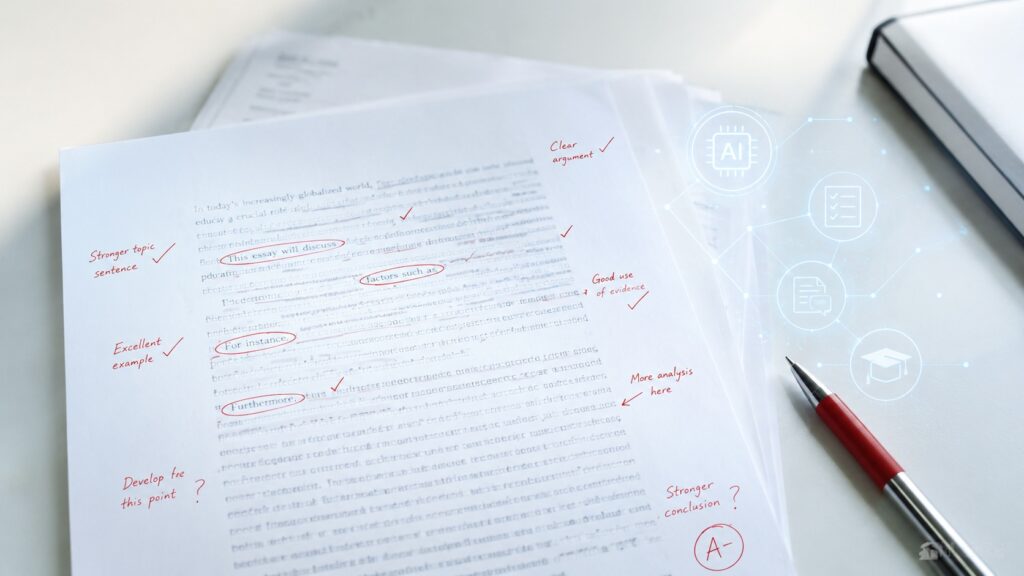
You’ve probably seen it by now, even if you didn’t have a word for it. The bland, over-explained, faintly robotic paragraph that says everything and nothing. The email that opens with “I hope this message finds you well” and never recovers. People have started calling this stuff slop: text that’s technically fine and completely forgettable. And here’s the uncomfortable part. A lot of the time, the machine isn’t the problem. We are.
Because a language model doesn’t invent slop out of nowhere. It gives you back a version of what you asked for. Feed it a lazy, shapeless request and it fills the space with the safest, blandest thing it can find. Slop in, slop out. The quality of what comes back is tied, more tightly than most people realise, to the quality of what you put in. And what you put in is language.
Prompting Is Just Talking Well, Under Pressure
There’s a myth that “prompting” is some new technical trick, a set of magic words you memorise. It isn’t. Prompting is just the old skill of saying what you actually mean, made suddenly visible. When you talk to a person, they fill in your gaps. They read your tone, your history, the look on your face. A model has none of that. All it has is your words, exactly as you wrote them. So every vague pronoun, every “make it better” with no sense of what better means, every request that hasn’t decided what it wants, gets exposed.
That’s why the people who get remarkable things out of these tools tend to be the same people who were already good with words. They know the difference between “summarise this” and “pull out the three claims this article is actually making and tell me which one is weakest.” They know that “write me a poem” and “write me eight lines, no rhyme, about missing someone you never met” produce completely different worlds. The skill was never about the AI. It was about knowing your own mind well enough to describe it.
The Fine Gradations Do the Heavy Lifting
What’s fascinating is how small the adjustments are that separate slop from something genuinely useful. It rarely comes down to length or effort. It comes down to precision. A single verb changes everything. “Explain” gives you a lecture; “walk me through” gives you a hand on the shoulder. “Analyse” and “critique” send the model down entirely different roads. Naming your audience does more work than a whole paragraph of instructions: “explain it to a curious ten-year-old” and “explain it to a examiner” are not the same request, and you can feel the difference in the answer.
- The verb sets the direction. Distil, compare, argue, outline — each one is a different job.
- Scope keeps it honest. “Give me three” beats “give me everything” almost every time.
- Register sets the voice. Formal, plain, playful — you choose, or the model chooses for you.
- Naming the reader sharpens all of it. Who is this for? That single answer reshapes the whole reply.
Which Is Really a Story About Learning
If any of this sounds familiar, it should. It’s exactly what we ask students to do when we teach them to write. Choose the right word. Cut the padding. Decide who you’re talking to. Say the thing you mean instead of circling it. The habits that keep slop out of an essay are the same habits that get a good answer out of a model, and it works in both directions: students who practise talking to these tools with care are, without quite noticing, practising the craft of writing itself.
There’s a nice symmetry to how the models get built, too. They’re trained on oceans of text and then patiently corrected, nudged toward answers that are clearer and more useful, one small refinement at a time. That’s not so different from how anyone learns to communicate. You read a lot, you try, you get feedback, you adjust. Fluency isn’t a switch that flips. It’s thousands of tiny corrections that eventually settle into instinct.
So Learn to Ask
The reassuring news is that avoiding slop isn’t a gift some people are born with. It’s a skill, and it’s the same skill whether you’re writing an essay, sending an email, or talking to a machine that answers back. Strong command of English stops being a box to tick on an exam and starts being a lever: the clearer you can make your thinking, the better everything downstream becomes. So the next time you sit down with an AI and get something flat and forgettable, resist the urge to blame the tool. Look at what you asked. Then ask again, better. That habit, more than any clever trick, is what turns slop into something worth reading. Every word really does count.
Welcome back, everyone! I’ve been thinking this week about how much of description is really about absence — about learning to see what isn’t there. English gives us a rich vocabulary for things that are present and busy, but describing an empty room asks something harder of you: you have to make nothing itself feel like something.
Notice how the language keeps reaching for the vocabulary of leftovers when it talks about empty spaces. A room is “deserted”, a street is “abandoned”, a house “stands empty” — every word smuggles in the memory of the people who were there a moment ago. Emptiness, in English, is almost never neutral; it is always haunted by its recent past. That is exactly the effect a strong descriptive writer can exploit.
This week’s essay prompt: “Write a description of a café just after it has closed.” — Question 2 from the October/November 2025 Paper 2 series.
Here’s what makes this prompt quietly demanding: the word that matters most is “just”. Not a café that has been shut for years and gone to ruin, but a café in the strange, warm minute immediately after the last customer leaves — when the machine is still cooling and the smells still hang in the air. The task is really about a threshold, a held breath between one state and the next.
The danger is treating it as an inventory: chairs, tables, counter, done. The strongest responses resist the checklist and instead give the empty café a kind of afterlife, letting the space remember the day it has just had. They move the focus deliberately — from light, to sound, to smell, to silence — rather than simply listing objects, which is precisely what the Cambridge mark scheme rewards at the top band.
The full essay is available for our premium members and is also marked and graded according to the IGCSE First Language English official rubrics and marking criteria. By reading it, you can see how a top-band description turns a mundane café into a living thing that has been fed all day and is finally, quietly, resting.
And if you want to know how your own writing measures up, our IGCSE Essay Marker gives you instant, rubric-aligned feedback on your own descriptive and narrative compositions in seconds.
If you haven’t signed up already, then make sure to sign up over here!
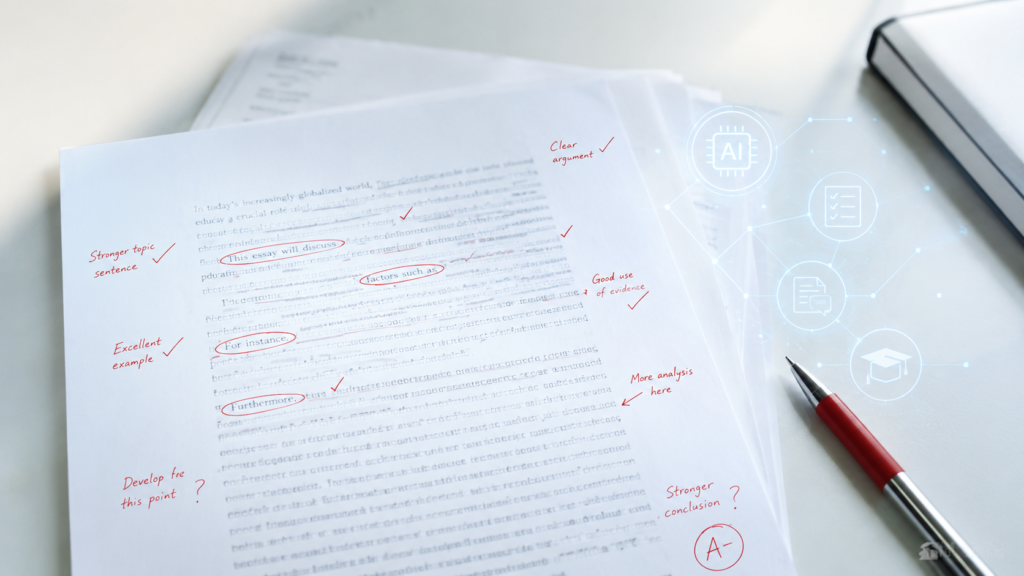
This is an AI-powered tool available exclusively to our premium members and that solves an immediate problem: Iterated feedback.
Simply insert your essay (written as a text document) and receive an instant grade. To access it, join as a Premium Member via our membership sign-up page. The tool is calibrated to the Cambridge IGCSE English First Language 0500 syllabus and was developed with feedback from FirstLanguageEnglish teachers.
Premium members receive 20 marked essays every month. You can mark Paper 1 (summary writing and extended response to reading) and Paper 2 (extended response to writing) as well as descriptive and narrative writing essays.