
One of the many things that First Language English asks you to do is to learn how to write a summary!
Seems obvious?
Well…
It isn’t, really.
See, when people hear ‘summary’, they immediately think that this means shortening an essay until it becomes something miniature – a compression of a long piece into something bite-sized… But is that what you need to do?
Let’s explore!
In the IGCSE First Language English exam, summary-writing is examined in question 1f).
Here’s a text and an example question from Summer 2022, Paper 1, Variant 3, provided here for your consideration:

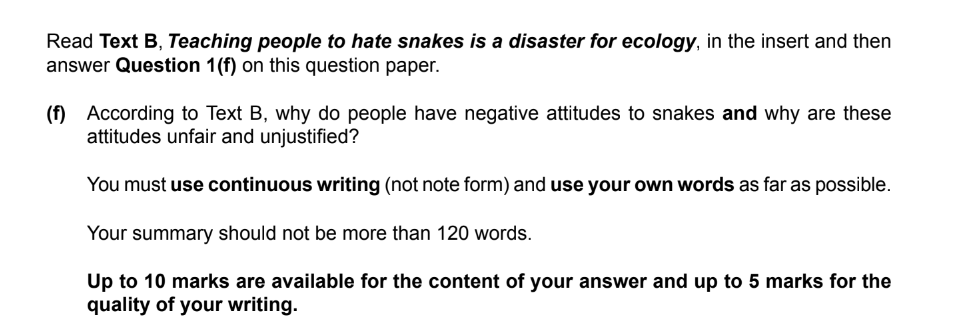
Alright! We can tell a few things about this:
- They’re not asking you to shorten the text.
The text is titled “Teaching people to hate snakes is a disaster for ecology”, and the question is asking you “why do people have negative attitudes to snakes and why are these attitudes unfair and unjustified?”. You should be answering the question, not looking at every sentence and trying to find a ‘shorter’ way of writing it. - They are asking you to find specific points in the text that answer the question.
You are looking for points that answer the specific question that was being asked. “Humans often fear what they don’t understand” is a good point to note – we don’t need to know about the Zoo Chats or anything else in the third paragraph as that doesn’t answer the question. - They are asking you to cut out irrelevant points.
Not everything in the text is relevant – If I’m receiving a summary from someone titled “Why people have negative attitudes towards snakes and why these attitudes are unfair and unjustified”, I’m not going to care about when World Snake Day is or anything else.
To effectively write a summary for IGCSE First Language English and obtain the highest possible score in an exam, follow these steps:
- Read the task prompt:
You have no idea how many summaries I have read in my lifetime that didn’t work because the student just went and tried to shorten the text. Please don’t do this – instead, please read the task prompt.
No matter what, your summary needs to match the question, and you need to make sure that it addresses the essential points of the question.
This is crucial, because you are not trying to shorten the entirety of the text – you are looking for the points that respond directly to the question, and hence you will have to select those points out.
- Read the passage carefully:
Remember the task prompt, then thoroughly read the given passage to fully understand its content, context, and main ideas. - Identify key points:
As you read, make note of the main points and any supporting details in relation to the task prompt – i.e. since they’re asking “Why people have negative attitudes towards snakes and why these attitudes are unfair and unjustified”, look for parts of the text where you can find answers to those specific questions.
Highlight them, then start thinking about how you can arrange or combine them into your summary. - Organize your ideas:
Once you’ve managed to decide which points belong in your summary, group the main points and supporting details in a logical order that supports the prompt. Note that often, this will cause you to end up with a chaotic list of things – so you need to start thinking about how you are going to combine the points with one another. - Paraphrase:
By this point, you have a list of points highlighted on the insert – now, you have to think about how to combine them into concise sentences that capture what you need.
Note that often, less is more. - Keep it concise:
A summary should be brief and to the point.
Aim to include only the most important information, and avoid any unnecessary details, examples, or personal opinions.
When in doubt, look at any part of your summary and ask:
“Does this answer the question?” - Use appropriate language:
Avoid slang, contractions, and colloquialisms. - Review the task prompt:
As you write your summary, continually refer back to the task prompt to ensure you’re addressing all requirements. This will help you stay focused and avoid straying from the task at hand. - Edit and proofread:
Once you’ve written your summary, take the time to carefully review and edit it. Look for any errors in grammar, punctuation, or spelling, and correct them as needed.
Oh wait, what’s that? The last tip? - Practice:
This is probably common sense, but in case it’s not… Practice!
Showing up makes a difference even if you don’t notice that it’s happening – let yourself have the time and space to process things in your mind, and keep doing it even if you don’t immediately see the results; that’s how you give yourself the opportunity to grow and get better at this, one step at a time.
Scheduling a good time for yourself or even using ChatGPT to remind yourself can be helpful, and so is doing the summary task under timed conditions – it might be hard at first to finish in the given time and you may overshoot, but trust your brain and its ability to learn: That’s why we’re here, and that’s something that is perfectly in your capacity.
And that’s it for now!
We hope you enjoyed this piece – enjoy, and have a wonderful one ahead!
V.







Ivy
Hi Victor,
Thank you for the detailed procedures & tips to write a good summary. We are looking forward to more samples of the summary soon!
Regards,
Ivy
victortanws
Hi Ivy! Thank you so much for the kind comment!
I will provide a couple of examples soon! Thank you for reading and for following this work, and I hope it will benefit many more students in the years to come!
🚀🚀🚀💪💪💪