Complete Breakdown: Text Types in IGCSE English First Language 0500
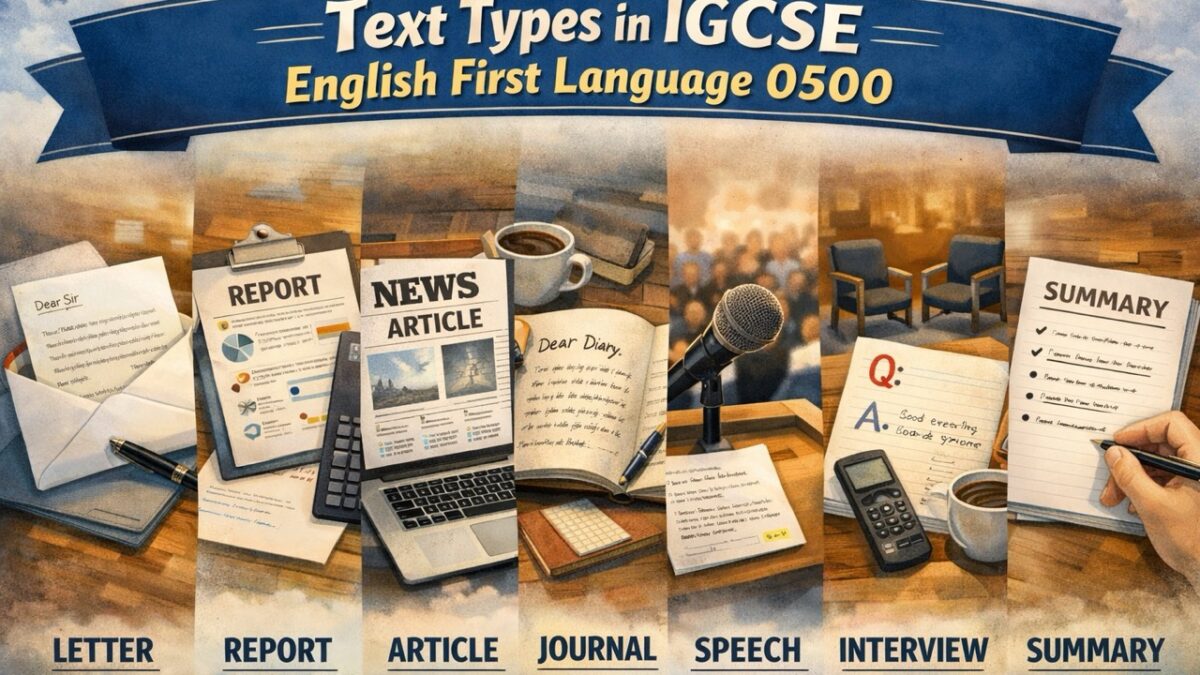
As you know, the Cambridge IGCSE First Language English 0500 wants you to develop an awareness and familiarity with different types of texts throughout the entire duration of the course. As it turns out, there are a few official ones that you have to be aware of. With that in mind, according to the official Cambridge syllabus, students must be able to write in the following text types:
- Letter
- Report
- Article
- Journal
- Speech
- Interview
- Summary (specific to Paper 1 only)
These appear in two key places in the exam:
Paper 1, Question 3 (Extended Response):
- Letter, Report, Journal, Speech, Interview, or Article
- 250-350 words
- Based on Text C
Paper 2, Section A (Directed Writing):
- Speech, Letter, or Article
- 250-350 words
- Discursive/argumentative/persuasive writing
Coursework Assignment 1:
- “Any appropriate form” which can include: Letter, Article, Speech, or any text type suitable for discussing/arguing/persuading
Now let me break down each text type comprehensively.
For each of the text types, I will provide you with a format that you can use. The content structure, highlight the language features that should be present in your text, and also highlight a few common exam scenarios which you may encounter. Ready? Let’s go!
1. LETTER
Types:
- Formal Letter (to authorities, officials, newspapers, companies)
- Semi-formal Letter (to teachers, coaches, community leaders)
- Informal Letter (to friends, family – rarely tested in IGCSE)
Purpose:
- To communicate a message to a specific person or organization
- To request, complain, inform, persuade, or apply
Key Features:
Formal Letter Format:
Your address (sender's address)

[Leave a line]

Date
[Leave a line]
Recipient's name and title
Recipient's address

[Leave a line]

Dear Sir/Madam, OR Dear Mr/Ms [Surname],

[Leave a line]

CONTENT IN PARAGRAPHS

[Leave a line]

Yours faithfully, (if you used Sir/Madam)
OR
Yours sincerely, (if you used their name)

[Leave a line]
Your signature
Your name (printed)
Content Structure:
- Opening paragraph: State purpose clearly and immediately
- Middle paragraphs: Develop your points with specific details (one point per paragraph)
- Closing paragraph: State desired outcome or call to action
- Sign off appropriately
Language Features:
- Formal tone: No contractions, slang, or colloquialisms
- Polite but assertive language: “I would appreciate,” “I am writing to express,” “I strongly believe”
- Clear, organized paragraphs
- Appropriate register for audience
Common Exam Scenarios:
- Letter to newspaper editor arguing a position
- Letter to local council about a community issue
- Letter responding to an article writer
- Letter of complaint or request
2. REPORT
Purpose:
- To present findings, observations, or information in an organized, objective manner
- To inform decision-makers
- To provide analysis and recommendations
Key Features:
Format:
TITLE: Report on [Topic]
OR
[Company/Organization Name] - Report

Prepared by: [Your name/position]
Date: [Date]
For: [Recipient/audience]

Introduction/Purpose
[What this report is about and why it was commissioned]

Findings/Main Body
[Organized sections with subheadings if appropriate]
- Finding 1
- Finding 2
- Finding 3

Conclusion
[Summary of key points]

Recommendations
[Specific suggestions for action]
Language Features:
- Objective, impersonal tone: Use third person or passive voice
- Formal language: No personal opinions stated as such
- Clear organization: Use headings and subheadings
- Factual presentation: Based on observations or data
- Professional vocabulary: “It was observed that,” “The findings indicate,” “It is recommended that”
Content Structure:
- Introduction: Outline purpose and scope
- Main body: Present findings systematically (can use bullet points sparingly)
- Conclusion: Summarize key observations
- Recommendations: Suggest practical actions (optional but often expected)
Common Exam Scenarios:
- Report on working conditions
- Report on facilities or services
- Report on an event or experience
- Report to management/authorities
3. ARTICLE
Types:
- Magazine Article (feature pieces, opinion pieces)
- Newspaper Article (news reports, editorials, opinion pieces)
- Online Article (blog-style pieces)
Purpose:
- To inform, entertain, persuade, or provoke thought
- To engage a wide audience on a topic of interest
Key Features:
Format:
HEADLINE
[Catchy, attention-grabbing, possibly using puns or alliteration]

Subheading (optional)
[Expands on headline, provides context]

By [Your name] (optional)

INTRODUCTION PARAGRAPH
[Hook the reader immediately]

BODY PARAGRAPHS
[Develop your points with evidence, examples, anecdotes]

CONCLUSION
[Strong ending - call to action, provocative question, or memorable statement]
Language Features:
- Engaging, lively style: Can be more creative than reports
- Direct address to reader: “Have you ever wondered…”, “We all know that…”
- Varied sentence structures: Short sentences for impact, longer for development
- Rhetorical devices: Questions, repetition, rule of three
- Personal voice: Can use “I” and express opinions clearly
- Varied vocabulary: Mixture of formal and informal depending on audience
Content Structure:
- Headline: Make it grab attention
- Opening: Hook reader with interesting fact, question, or anecdote
- Development: Build argument or present information engagingly
- Conclusion: Leave reader thinking or call them to action
Common Exam Scenarios:
- Article arguing for/against a position
- Article discussing a topical issue
- Feature article on an experience or topic
- Opinion piece for a magazine
4. JOURNAL/DIARY
Purpose:
- To record personal thoughts, feelings, and experiences
- To reflect on events from a personal perspective
- To explore emotions and reactions
Key Features:
Format:
Date: [Day, Date, Month, Year]
OR
Dear Diary,

[PERSONAL REFLECTIONS AND NARRATIVE]

[No sign-off necessary, or simple:]
[Your name/initials]
Language Features:
- First person narrative: Extensive use of “I”
- Personal, reflective tone: Honest, introspective
- Informal register: Can use contractions, colloquial language
- Present or past tense: Depending on when writing occurs
- Emotional expression: Share feelings openly
- Conversational style: Like talking to yourself or a trusted confidant
Content Structure:
- Opening: Set scene/context (“Today was…,” “I can’t believe…”)
- Development: Narrate events and express feelings about them
- Reflection: Analyze what happened, what it means, how you feel
- Conclusion: Look forward or sum up emotional state
Common Exam Scenarios:
- Diary entry after a significant experience
- Journal reflecting on events described in text
- Multiple entries showing progression of thought/feeling
- Personal response to a situation
5. SPEECH
Purpose:
- To persuade, inform, entertain, or inspire an audience
- To present arguments or ideas orally (though written on paper)
- To create connection with listeners
Key Features:
Format:
[Optional greeting/opening]
"Good morning, ladies and gentlemen," / "Thank you for coming today,"

[MAIN CONTENT - written as if spoken]

[Optional closing]
"Thank you for your attention." / "I hope you'll join me..."
Language Features:
- Direct address: “You might think,” “We all know,” “Ask yourselves”
- Rhetorical devices:
- Rhetorical questions
- Rule of three (lists of three)
- Repetition for emphasis
- Anaphora (repeated sentence openings)
- Emotive language
- Conversational connectives: “Now,” “So,” “But here’s the thing”
- Inclusive language: “We,” “us,” “our”
- Varied pace: Short, punchy sentences mixed with longer development
- Signposting: “Firstly,” “Furthermore,” “In conclusion”
Content Structure:
- Opening: Grab attention, establish credibility, state purpose
- Development: Present arguments with evidence and examples
- Address counter-arguments: Show you’ve considered other views
- Conclusion: Summarize key points, powerful ending, call to action
Common Exam Scenarios:
- Speech to school assembly
- Speech to local council
- Debate speech arguing a position
- Campaign speech
- Speech responding to an article
6. INTERVIEW
Purpose:
- To present information through question-and-answer format
- To reveal character, opinions, or experiences
- To make information accessible and engaging
Key Features:
Format:
[Optional Introduction]
"Today we speak with [Name] about [Topic]..."

Q: [Question from interviewer]
A: [Answer from interviewee]

Q: [Question]
A: [Answer]

[Continue...]

[Optional Conclusion]
"Thank you for your time..."
Language Features:
- Two distinct voices:
- Interviewer: Professional, probing questions
- Interviewee: Personal responses, revealing information
- Question variety:
- Open questions (“Tell me about…”)
- Probing questions (“Why did you…?”)
- Follow-up questions (“You mentioned… can you explain?”)
- Natural conversational flow
- Mix of formal and informal depending on context
- Reveal information gradually
Content Structure:
- Introduction: Set context, introduce interviewee
- Opening question: Ease in, establish rapport
- Development: Deeper, more probing questions
- Key questions: Address main points from source text
- Closing: Wrap up, thank interviewee
Common Exam Scenarios:
- Interview with person from the text
- Interview with expert on topic
- Interview revealing character’s thoughts/motivations
- Interview exploring different perspectives
7. SUMMARY (Paper 1 Only)
Purpose:
- To condense key information from a text
- To demonstrate understanding of explicit and implicit content
- To present information concisely in own words
Key Features:
Format:
[Continuous prose paragraph(s)]
[No introduction or conclusion]
[Approximately 120 words for Paper 1]
Language Features:
- Own words: No lifting from text
- Third person: Objective presentation
- Present tense: Usually (unless text is clearly past)
- Concise expression: Every word counts
- No personal opinion: Stick to text content
- Selective detail: Only relevant points
Content Structure:
- Open with context: Brief statement of what’s being summarized (use question wording)
- Present points: One after another, no unnecessary elaboration
- No introduction: Get straight to first point
- No conclusion: Stop when points are covered
Critical Rules:
- Do not copy phrases from text
- Do not add your own opinions
- Do not include examples unless specifically asked
- Do not exceed word limit significantly
- Do cover all bullet points if given
- Do use connecting words for flow
Where Each Text Type Appears:
Paper 1, Question 3:
You’ll be given ONE of these six options:
- Letter
- Report
- Journal
- Speech
- Interview
- Article
You must respond in the specified format (250-350 words)
Paper 2, Section A (Directed Writing):
You’ll write ONE of these three:
- Speech
- Letter
- Article
Purpose: Discursive, argumentative, or persuasive (250-350 words)
Coursework Assignment 1:
“Any appropriate form” – typically:
- Letter (most common)
- Article
- Speech
- Report (less common but acceptable)
Key Principles Across All Text Types:
- Audience Awareness:
- Who are you writing for? You should have a sense of who the audience is and what you must do when you are speaking to each audience.
- Formal or informal? Depending on the social situation and the types of people that you’re speaking to, you may need to vary your language. If you’re speaking at a conference, clearly your language should be formal; if you are writing to elementary school children, you can not be using Ph.D.-level language.
- What do they know already? Think about this as you write.
- Purpose Clarity:
- What are you trying to achieve?
- Inform? Persuade? Entertain? Reflect?
- Register Appropriateness:
- Match tone to text type and audience
- Consistent throughout
- Structural Coherence:
- Clear beginning, middle, end
- Logical progression of ideas
- Appropriate linking between points
- Content Relevance:
- Stay focused on the task
- Use material from source text appropriately
- Develop ideas fully
Common Mistakes to Avoid:
❌ Mixing formats (starting as letter, ending as article)
❌ Ignoring conventions (no address on letter, no headline on article)
❌ Wrong register (too informal for report, too formal for journal)
❌ Lifting text (especially in summaries)
❌ Irrelevant content (straying from the text/task)
❌ No clear audience (writing to nobody in particular)
❌ Inconsistent voice (switching between perspectives)
Final Thoughts:
The text types aren’t just about format – they’re about understanding how purpose, audience, and form interact. A letter arguing against a policy will look different from a speech arguing the same point, even though both are persuasive. The letter is targeted to a specific recipient with formal conventions; the speech addresses a crowd with rhetorical flourishes.
Practice each text type until the conventions become automatic. Then you can focus on what really matters: the quality of your ideas, the sophistication of your expression, and the effectiveness of your communication.
The examiners aren’t just checking if you put “Dear Sir/Madam” at the top – they’re assessing whether you can adapt your writing to different contexts, audiences, and purposes. That’s what W4 (use register appropriate to context) is all about.