Welcome to the ultimate guide to conquering the 0500 First Language English exam!
Whether you’re a student or a teacher, we are confident that you’ll find some value here. The materials on this site will break down the IGCSE First Language English curriculum for you, offer you some helpful tips, and provide you both with a rough outline as well as in-depth guides to success, even and especially if you’ve never done well on this subject in the past.
Some of the materials are free, and others are premium materials accessible if you choose to purchase membership access.
If you are preparing for the 2024-2026 exams and are a candidate for the October November 2026 exams, go here!
Here is the site directory!
Site Directory:
- Syllabus-related
- Paper 1
- Summary (Question 1(f))
- Writer’s Effect (Question 2(d))
- Paper 2
- Directed Writing
- Descriptive Writing
- Narrative Composition
- Coursework
- Text types
- Tips for optimizing your time for exam practice
- Resources and publications
- FirstLanguageEnglish.com – 56 Descriptive and Narrative Essays
- The Complete Grammar Guide for IGCSE English
- The Complete Writer’s Effect Toolkit: A Student’s Guide to Achieving Level 5 (13-15 marks)
- More to come!
Also, it IS a blog, so you’ll get some of my thoughts here, there, and everywhere.
First Language English isn’t easy, but I hope this helps you out! Any and all purchases that you make from the website will help support my work and allow me to provide more value to you in the future. Thank you for your support!
If you find this work valuable, do consider sharing it over social media, sharing it with your students, feel free to integrate it into your lesson plans as well, and make sure to learn as much as you can during this epic time ahead 🙂
…What are you waiting for?
Go forth and succeed! Happy reading!

Welcome back, all!
It is officially September, which means about a month until the October-November 2026 exams, the final exams on the 2024-2026 syllabus before all subsequent exams transition to the 2027-2029 syllabus.
There is a peculiar thing that happens as an examination approaches: revision seems to expand.
One more video. One more set of notes. One more past paper opened in a new tab and never quite completed. Before long, you are extremely busy—but not entirely sure whether any of this activity is improving your performance even as all the other exams loom, one after another!
If there’s one thing I’ve learned from all these years, it is this: Panic is very good at producing activity. It is less good at producing marks.
Your task during the final sprint is not to become a completely different reader or writer. It is to make the skills you already possess more reliable under examination conditions.
This checklist, available for our Premium Members, will help you identify what is still costing you marks, choose the right kind of practice and arrive at the examination with a clear plan. If you do not have a premium membership but you would like to purchase the checklist nonetheless, you may do so here.
It is meant to make you brutally honest with yourself, identify where you are going wrong, and become honest with where you are with your preparations.
Let’s get into it!
Begin with a 90-second diagnosis.
Before completing another paper, tick the statements that genuinely describe your recent work:
Your final practical checks
During the final week:
- Confirm your component, variant, examination date, AM/PM session, venue and reporting time with your centre.
- Prepare several black or dark-blue pens.
- Remember that dictionaries, erasable pens and correction fluid are not permitted.
- Rehearse your timing checkpoints.
- Complete your last full mock early in the week.
- Reduce the volume of practice as the examination approaches.
- Protect your sleep and normal routine.
During the examination:
- Check the component and variant on the front cover.
- Read the instructions and mark allocations carefully.
- Answer every required question.
- Follow your rehearsed clock rather than perfecting one answer.
- Label any work on additional pages clearly.
- Use the final minutes to complete missing sections and correct avoidable errors.
After Paper 1, resist the temptation to conduct a lengthy post-mortem with friends. Paper 1 is finished. Your attention now belongs to Paper 2.
One final 2026 note: papers from March 2026 may look visually different from some older past papers. Cambridge has changed aspects of the presentation for accessibility, but states that the content, demand and question types remain unchanged. You can find official papers and updates on the Cambridge 0500 past-papers page.
A final word
The last days before an examination are not the time to reinvent yourself as a writer.
They are the time to become more consistent: to read the exact question, make deliberate choices, finish what you begin and remove the errors you already know you make.
A checklist cannot write the paper for you. What it can do is turn a cloud of anxiety into a sequence of decisions.
You do not need to feel perfectly ready. You need to know what to do next.
Choose one weakness. Complete one useful piece of practice today. Return tomorrow and do the next thing.
If you would like worked responses and a regular feedback loop rather than revising in the dark, you can explore EnglishFirstLanguage.net Premium membership. Premium members can also use the IGCSE Essay Marker for up to 20 eligible submissions each month.
Just want to purchase the checklist? That’s ok! You’ll find it here.
All the best with your preparations!
V.

Welcome back, all!
English does something rather mischievous in this examination.
It asks you to use your own words—and then gives you no credit if those words say something slightly different than what the examiner wanted.
If this seems silly and even slightly neurotic to you, don’t worry. You’re not alone. A lot of students face this problem, and they proceed to complain.
After all, why should it be that if you copy down exactly what was written in a question, those words are not your own? You wrote them down, didn’t you? Why is it that if you write whatever you want, the examiners can just fail to credit you? Isn’t your opinion equally valid? How can they judge you like this?
Anyway, cast aside the deep philosophical questions for a minute and consider:
This is how a perfectly sensible sentence enters the thesaurus and emerges wearing a top hat, three adjectives and somebody else’s meaning.
“Could” becomes “will”.
“Several” becomes “everyone”.
“Considered leaving” becomes “left”.
The vocabulary has changed.
Unfortunately, so has the truth.
What happened was that, in writing the alternatives that seemed plausible, you ended up changing the meaning of what was written. What you were supposed to do was preserve the meaning.
Using your own words is not principally a vocabulary test. It is a test of whether you can identify the meaning underneath a sentence and rebuild it accurately.
The object is not to make the sentence look different at any cost. The object is to show that you understand it well enough to reconstruct it.
Or, more simply:
Change the language. Keep the truth.
Syllabus note: The question references in this article follow the Cambridge IGCSE First Language English 0500 syllabus and specimen papers for examinations from 2027.
Where do “own words” appear in the 0500 examination?
The instruction appears in several forms across both papers.
| Part of the examination | What “use your own words” requires |
|---|---|
| Paper 1 Question 1(b) | Explain the complete contextual meaning of a phrase |
| Paper 1 Question 1(e)(ii) | Convey the relevant ideas predominantly in independent language, according to the mark scheme |
| Paper 1 Question 2(a) | Select and summarise ideas using your own words as far as possible |
| Paper 1 Question 3(b) | Explain the contextual meaning of individual words |
| Paper 1 Question 3(c) | Select exact evidence but explain its meaning and effect independently |
| Paper 1 Question 4 | Transform source material into a convincing new response and voice |
| Paper 2 Question 1(a) | Evaluate an attitude in your own words while supporting the judgement with textual details |
| Paper 2 Question 1(b) | Synthesize ideas from both texts into a new argument, form and voice |
The operation is not identical in every question.
Sometimes you are translating a short phrase. Sometimes you are compressing several ideas into a summary. Sometimes you are explaining a writer’s imagery. Sometimes you are transforming the material into an article, letter, interview or speech.
That leads us to an important distinction:
Evidence may need to remain in the writer’s words. The explanation must be in yours.
If a question asks you to identify a word or phrase from the text, copy the relevant wording accurately. Do not paraphrase the evidence and then wonder why the examiner cannot find it.
Own words are not required everywhere. Read the precise instruction.
Own words do not mean different words
This is the misconception we need to remove first.
Paraphrasing is not:
- Find every important word.
- Replace it with a synonym.
- Hope for the best.
Consider this sentence:
Although Naila had considered cancelling the market, she agreed to a smaller event because traders depended on the income.
A word-by-word approach might produce:
Despite Naila wanting to terminate the market, she organised a brief sale to assist impoverished shopkeepers.
It certainly looks different. It is also inaccurate.
- Considered has become the stronger wanted.
- Smaller has become brief, changing size into duration.
- Agreed to has become organised, changing Naila’s role.
- Depended on the income has become impoverished, adding information that was never stated.
- Traders have become shopkeepers, although those are not necessarily the same thing.
A sound version would be:
Despite thinking about calling it off, Naila approved a reduced market because the vendors relied on the money they earned there.
The sentence has changed, but its essential meaning has survived.
Here is how you deal with “use your own words” in the IGCSE 0500 exam. Ready? Let’s go!
Final thoughts
“Use your own words” sounds like an instruction about vocabulary.
In reality, it is an instruction about understanding.
A student with a vast vocabulary can still produce an inaccurate paraphrase. A student using simple, precise language can produce an excellent one.
Do not begin by hunting for replacements.
Find the meaning. Reduce it to its skeleton. Rebuild it naturally. Then check that the truth has survived.
Premium members can practise this process using the model response and question resources available through EnglishFirstLanguage.net membership. You can also use the IGCSE Essay Marker to examine whether your summary, directed-writing or extended-response language remains precise and properly grounded in the source.
Better own-word writing does not begin with a larger thesaurus.
It begins with more exact reading.
Change the language. Keep the truth.
V.
Welcome back, all — and, fittingly for our final essay in this series, let’s talk about the language of not giving up. English has a whole gritty little vocabulary for it: “grit”, “guts”, “backbone”, “stickability”. Notice how bodily they are again — willpower is imagined as something physical, something in the spine and the jaw, not the mind. We locate determination in the body because that is where it is actually felt.
There’s also the strange power of counting. “One more step.” “Just five more.” When we are at our limit, we shrink the future down to the next single unit, because the whole distance is unbearable but the next step is not. That’s not just psychology; it’s a rhythm, and rhythm is something prose can reproduce on the page.
This week’s essay prompt: “Write a story that involves someone showing determination.” — Question 5 from the October/November 2025 Paper 2 series.
Here’s the danger: “determination” invites the epic — climbing the mountain, winning the final. But scale is not the same as intensity. The strongest responses often shrink the goal right down — a few steps between parallel bars — and mine that small, close-range struggle for far more drama than a montage of triumphs ever could.
The most sophisticated writers understand that determination isn’t really the cheering or the finish line; it’s the quiet, offered exit — the open door back to the easier thing — and the choice to shut it. A top-band narrative locates its climax in that refusal, not in the victory.
The full essay is available for our premium members and is also marked and graded according to the IGCSE First Language English official rubrics and marking criteria. By reading it, you can see how a top-band narrative counts twelve small steps between parallel bars into a study of willpower — and how a character shifting their goal from “twelve” to “fourteen” can end a story on pure, earned defiance.
And if you want to know how your own writing measures up, our IGCSE Essay Marker gives you instant, rubric-aligned feedback on your own descriptive and narrative compositions in seconds.
If you haven’t signed up already, then make sure to sign up over here!
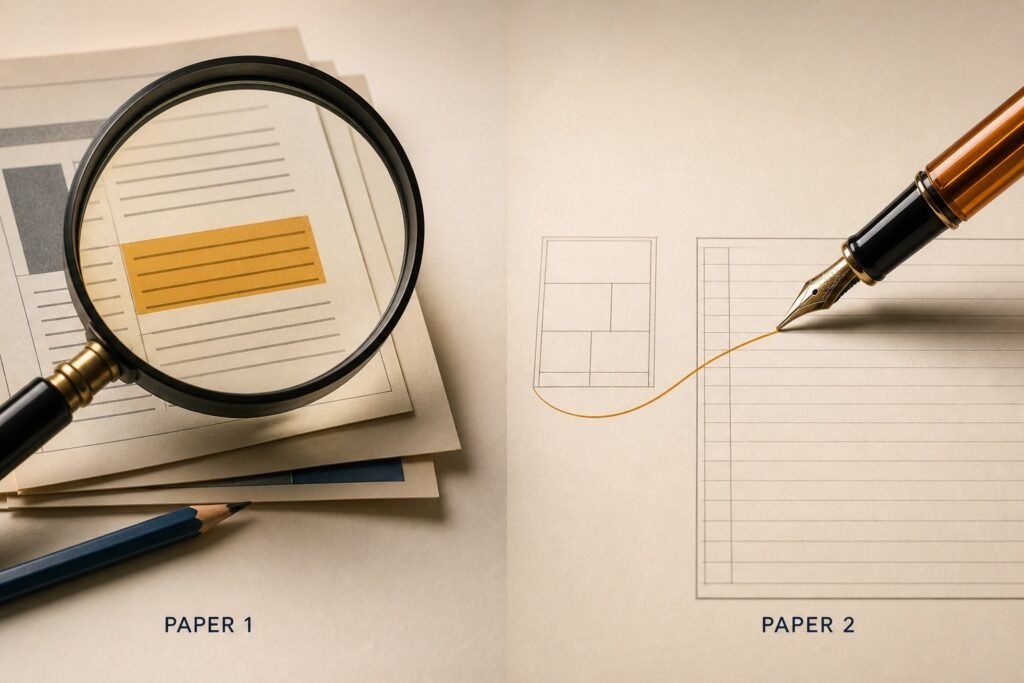
Why Paper 1 is not simply comprehension, Paper 2 is not simply creative writing—and revising both in the same way is a mistake.
Syllabus note: This article follows the Cambridge IGCSE First Language English 0500 syllabus for examinations in 2027, 2028 and 2029. If you are sitting the examination in 2026, some question numbers and mark allocations will be different.
Welcome back, all!
Paper 1 and Paper 2 look rather like siblings.
Each lasts two hours. Each carries 80 marks. Each contributes exactly half of your final grade.
But they are not twins.
Paper 1 asks whether you can hear what a text is really saying—even when its most important meanings are not stated directly.
Paper 2 asks whether you can make language say precisely what you intend.
One rewards disciplined interpretation. The other rewards deliberate authorship.
If you revise both papers by simply “doing more essays”, you are training two rather different sets of muscles as though they were one.
So what is Cambridge actually testing?
Let’s take a closer look.
The short answer: reader first versus writer first
The numerical contrast is remarkably neat:
| Paper | Reading marks | Writing marks | Central demand |
|---|---|---|---|
| Paper 1 | 65 | 15 | Understand, select, infer, analyse and transform |
| Paper 2 | 15 | 65 | Evaluate, organise, craft and control |
Together, the two papers provide:
- 80 Reading marks
- 80 Writing marks
The qualification as a whole is perfectly balanced. The individual papers are not.
Paper 1 is reading-led, but still requires controlled writing. Paper 2 is writing-led, but still requires critical reading.
A useful way of expressing the distinction is this:
Paper 1 asks: What does this text allow you to say?
Paper 2 asks: Given this purpose and audience, what is the best thing to say—and how should you say it?
The mark allocations come directly from Cambridge’s official 2027–29 syllabus.
For the complete question-by-question structure, see the companion guide to the Cambridge IGCSE 0500 exam format for 2027–29.
What Paper 1 is actually testing
Paper 1 is not testing how much of the text you can copy.
Nor is it testing how many literary techniques you have memorised.
It is testing whether you can move from seeing, to understanding, to explaining, and finally to re-voicing a text.
Can you notice precisely?
Question 1 tests much more than basic retrieval.
You may need to:
- Locate an explicit fact
- Recognise an implied meaning
- Explain a phrase in your own words
- Distinguish between similar ideas
- Select information for a particular purpose
- Explain why the writer chose one expression rather than another
A careless reading error at the beginning can quietly damage everything that follows.
This is why a polished sentence does not rescue an answer to the wrong question. In Paper 1, precision comes before elegance.
If short-answer questions are costing you marks, begin with the broader guide to Reading Comprehension in IGCSE Paper 1.
Can you paraphrase without changing the meaning?
“Use your own words” does not mean replacing every word with something that sounds more sophisticated.
It means preserving an idea while changing its language.
That requires genuine understanding.
If you replace a word mechanically using a thesaurus, you may produce a sentence that sounds impressive but means something slightly—or completely—different.
Paper 1 therefore tests whether you can separate an idea from the wording in which you first encountered it.
This is central to both comprehension and summary writing.
Can you select rather than collect?
The summary task is one of the clearest tests of disciplined selection.
A weak candidate often asks:
How many things from the passage can I include?
A stronger candidate asks:
Which ideas answer this exact question?
Those are very different questions.
Cambridge rewards a relevant range of distinct ideas, careful selection, clear organisation and concise expression. Excess material can be just as damaging as missing material because it suggests that the candidate has not distinguished the essential from the merely interesting.
The same principle appears in the Extended Response. Using more details does not automatically demonstrate greater understanding. The details must be relevant, developed and adapted to the task.
Paper 1 rewards compression with fidelity: you control the selection and organisation, but the source still controls the underlying content.
Can you explain how language works?
Writer’s Effect is not a treasure hunt for metaphors.
The examiner is not awarding marks because you correctly identified personification and then moved on.
A strong analysis explains:
- What the selected word or phrase means in context
- What associations or connotations it carries
- What image it creates
- Why the writer’s choice is effective
- What the language contributes to the wider portrayal or atmosphere
The official Paper 1 specimen mark scheme makes an important point: the quality of analysis matters more than simply accumulating quotations.
Three precise, well-explained choices are more valuable than six quotations surrounded by vague comments.
If your analysis repeatedly says that something “creates an image in the reader’s mind”, revisit the Writer’s Effect marking-criteria deep dive.
Can you transform a text without escaping it?
Question 4, the Extended Response to Reading, can look rather creative.
You may be asked to write an interview, journal, speech, report, article or letter. You must adopt a role, establish a voice and develop ideas.
But it is not free creative writing.
The source remains the authority.
Your role, structure and expression may be imaginative, but the substance must remain grounded in Text C. Relevant implications can be developed; an entirely unrelated story cannot.
I sometimes see students become so enthusiastic about the role that they gradually abandon the passage. The response becomes lively and fluent—but earns few Reading marks because it no longer demonstrates what the candidate understood.
This is constrained creativity.
You have freedom over voice, organisation and development, but not freedom to betray the source.
Does spelling and grammar matter on Paper 1?
Here is an important technical distinction.
Paper 1 does not separately assess W5, the objective for spelling, punctuation and grammar.
That does not mean accuracy is irrelevant.
The summary still rewards clear, fluent and concise expression. Question 4 still rewards style, structure, vocabulary and language appropriate to audience and purpose. If an examiner cannot understand your sentence, they may not be able to credit the idea inside it.
So there is no separate SPaG assessment on Paper 1—but unclear writing can still conceal good reading.
What Paper 2 is actually testing
Paper 2 gradually hands the pen to you.
Section A still provides source material, but you must reorganise it around your own purpose and judgement.
Section B then removes the source altogether. You must generate, select and control the material yourself.
Paper 2 tests whether you can move from judging, to deciding, to shaping, and finally to controlling a piece of writing.
Can you judge ideas rather than repeat them?
Paper 2 begins with source material, but it is not another comprehension paper.
The five-mark Question 1(a) requires a short analytical or evaluative response. Question 1(b), Directed Writing, then asks you to use, develop and evaluate ideas from the text or texts.
Evaluation does not mean disagreeing with everything.
It may involve:
- Testing whether a claim is convincing
- Identifying an assumption
- Recognising a limitation
- Comparing competing viewpoints
- Qualifying an overly simple argument
- Exploring the consequences of an idea
- Deciding which position is most useful or reasonable
A response that merely reports what each writer says has not yet begun to evaluate.
For more on this distinction, revisit How to Evaluate in IGCSE First Language English.
Can you synthesise different viewpoints?
A weak Directed Writing response often follows this structure:
- Text A says…
- Text A also says…
- Text B says…
- Text B disagrees…
- In conclusion…
The source texts have become the paragraph plan.
Cambridge’s Paper 2 specimen mark scheme explicitly identifies reliance on the sources’ original sequence as a feature of lower-level writing.
A stronger response groups ideas by issue.
It might bring one claim from Text A together with a qualification from Text B, test both and then develop an independent judgement.
The goal is not to display the sources one after another. It is to assimilate them.
The sources provide the raw material. You decide what to build.
Can you control audience, purpose and form?
An idea should not sound identical in every context.
Advice written for teenagers entering the workplace should sound different from a formal report addressed to a school leadership team. A persuasive speech should not read like an academic essay with “Ladies and gentlemen” added to the first line.
Audience and purpose affect:
- Vocabulary
- Sentence structure
- Tone
- Level of formality
- Organisation
- Methods of engagement
- The balance between explanation and persuasion
Register is not decoration. It is part of meaning.
Before practising another directed response, make sure you understand the possible forms using the complete 0500 text-types breakdown.
Can you create and shape material independently?
In Section B, you choose one descriptive or narrative title and create the entire response.
There is no source passage to provide ideas. There is no list of content points waiting to be discovered.
You must decide:
- What the central concept will be
- What to include and exclude
- Where the focus should move
- How the response should develop
- What the reader should notice or feel
- How the ending should relate to the beginning
This is why a composition with an interesting premise can still receive a modest mark.
An idea is not yet a piece of writing.
It must be selected, structured, developed and expressed with control.
If your responses tend to begin energetically and then lose direction, revisit Should You Plan Your Essays?.
For genre-specific preparation, see the descriptive writing guide and the guide to narrative story structures.
Can you sustain technical control?
Unlike Paper 1, Paper 2 explicitly assesses spelling, punctuation and grammar across all 65 Writing marks.
In Directed Writing, the 25 Writing marks reward:
- Style
- Structure
- Vocabulary
- Audience and purpose
- Accuracy
In Composition, the 40 marks are divided into:
- 16 for Content and Structure
- 24 for Style and Accuracy
That does not mean there are a few separate grammar marks waiting to be collected at the end. The criteria are holistic. Accuracy operates alongside meaning, structure and effect.
Ambitious vocabulary used inaccurately is not sophisticated writing.
A complex sentence that collapses halfway through is not automatically better than a controlled simple one.
Paper 2 rewards deliberate language choices that work.
Paper 1 versus Paper 2
| Dimension | Paper 1 | Paper 2 |
| Primary role | Critical reader | Deliberate writer |
| Main question | What does the text allow me to say? | What should I say, and how should I say it? |
| Relationship to sources | Closely anchored to supplied texts | Source-led in Section A; independent in Composition |
| Core actions | Understand, infer, select, analyse, transform | Evaluate, synthesise, argue, imagine, craft |
| Freedom | Constrained by textual evidence | Increasing freedom across the paper |
| Own words | Demonstrate genuine understanding | Build an independent argument and voice |
| Creativity | Develop within the source’s boundaries | Generate and control original material |
| Structure | Serves selection, bullet coverage and textual transformation | Serves audience, purpose and reader experience |
| Accuracy | No separate W5 assessment, but clarity matters | W5 is directly assessed throughout |
| Typical weak response | Copies, misreads, generalises or invents | Retells sources, rambles, loses register or lacks control |
| Best focused practice | Precise reading and analysis drills | Planning, drafting, editing and redrafting |
The two papers quietly train each other
Paper 1 and Paper 2 are different, but they are not sealed revision boxes.
Each can improve the other:
- Summary writing teaches concision that strengthens Paper 2 arguments.
- Writer’s Effect develops the vocabulary awareness needed for composition.
- Paper 1 Question 4 develops voice and register for Directed Writing.
- Directed Writing evaluation strengthens Paper 1 attitude and inference work.
- Composition planning improves the structure of every extended response.
- Paper 2 editing habits improve clarity throughout Paper 1.
The best preparation therefore recognises both the differences and the connections.
Which skill is your mark exposing?
Do not respond to every disappointing result by completing another full paper.
First, diagnose the underlying weakness.
| What keeps happening? | Likely weakness | Best repair |
| You understand the passage but lose summary marks | Selection and compression | Harvest, group and paraphrase points |
| Your language analysis sounds repetitive | Contextual interpretation | Analyse one choice deeply before adding another |
| Your Extended Response becomes a new story | Source discipline | Plan evidence before development |
| Your Directed Writing retells both texts | Evaluation and synthesis | Group ideas by issue and test each claim |
| Your compositions contain ideas but feel shapeless | Deliberate structure | Map the purpose of each scene or paragraph |
| Your writing sounds ambitious but contains frequent errors | Technical control | Use targeted editing passes |
| You regularly answer a slightly different question | Task precision | Underline command words, audience and purpose |
This is the principle behind intelligent practice: identify the problem, isolate it, correct it and then test whether the improvement transfers.
How should you revise each paper?
For Paper 1
Prioritise:
- Short comprehension and inference drills
- Accurate paraphrasing
- Summary-point selection
- Precise language analysis
- Evidence-to-development planning
- Careful reading of command words
- Marking against the exact paper-specific mark scheme
Do not assume that longer answers are automatically stronger. On Paper 1, excess can reveal weak selection just as easily as brevity can reveal missing understanding.
For Paper 2
Prioritise:
- Evaluating claims rather than merely identifying them
- Grouping source ideas by issue
- Planning for audience, purpose and form
- Writing controlled paragraphs
- Developing descriptive and narrative structure
- Editing for sentence boundaries, tense, punctuation and precision
- Redrafting weak sections rather than merely starting another essay
Alternate targeted practice with occasional complete timed papers. Full papers test stamina and timing; focused drills are often better for repairing a specific weakness.
So which paper is harder?
There is no universal answer.
A fluent, imaginative writer may enjoy Paper 2 but lose Paper 1 marks through imprecise reading.
A careful, analytical reader may perform strongly on Paper 1 but struggle when asked to generate and sustain independent writing.
A highly creative student may need to learn source discipline. A formula-reliant student may cope with short questions but struggle when judgement is required.
The harder paper is usually the one that exposes the skill you have been able to avoid practising.
And perhaps that is the real value of the two-paper structure.
Paper 1 asks you to read with discipline.
Paper 2 asks you to write with intention.
The best students learn to do both.
Your next step
Once you understand the difference between the papers, practice stops being random.
You can choose a task because it develops the skill you need—not merely because it happens to be the next question in the booklet.
If worked examples and a regular feedback loop would help you practise more intelligently, you can explore EnglishFirstLanguage.net Premium membership and learn about the IGCSE Essay Marker.
Paper 1 rewards fidelity with intelligence.
Paper 2 rewards freedom with control.
All the best!
V.
Official Cambridge sources
Welcome back, everyone! Here’s a curious thing about how we talk about speed and power: our language runs out of literal words almost immediately and starts borrowing. A sprinter doesn’t just start quickly — she “explodes” out of the blocks. A runner doesn’t simply move fast — he “flies”. We reach for violence and for flight, because ordinary verbs are too slow to keep up with the body at full effort.
That’s the gift and the trap of describing an athlete. The gift is that the subject is inherently dramatic. The trap is that the obvious words — “powerful”, “fast”, “determined” — are exhausted before you begin. The strongest descriptive writing about the body finds fresh, exact images for effort, and knows that stillness can be as charged as motion.
This week’s essay prompt: “Write a description with the title, ‘The athlete’.” — Question 3 from the October/November 2025 Paper 2 series.
Here’s the craft point: a title this open invites a portrait, and the best portraits are structured. Rather than a shapeless list of muscles, the strongest responses move with deliberate control — from the whole crouched figure, to the body in close-up, to the strange calm of the face, to the explosion of the start.
A top-band writer often builds the whole piece around a single sustained image or conceit, and lets the form imitate the content — short, clipped sentences at the gun, long flowing ones as the runner unwinds down the track. That marriage of structure and subject is exactly what earns the highest band.
The full essay is available for our premium members and is also marked and graded according to the IGCSE First Language English official rubrics and marking criteria. By reading it, you can see how a top-band description sustains a single conceit — the athlete as an unsent letter, folded in the blocks and then “sent” at the gun — and how the finish can exist for a runner “already, a memory arriving early”.
And if you want to know how your own writing measures up, our IGCSE Essay Marker gives you instant, rubric-aligned feedback on your own descriptive and narrative compositions in seconds.
If you haven’t signed up already, then make sure to sign up over here!