I was scrolling through my phone the other day when I felt it—that particular kind of nausea that comes from watching someone perform morality in real-time.
You know the type. The moral defender. The person who swoops into every conflict with their cape of righteousness, insisting that we all need to “be more tolerant,” “show kindness,” “practice understanding.”
The fascinating thing is that the person who was using all these words was basically trying to manipulate people into agreeing with them while proclaiming that they were the most wonderful, because we were pointing out that a member of the group was advertising to us against the group rules.
I wanted to throw my phone across the room.
Not because I’m against tolerance or kindness—I’m not a sociopath. But because I could see exactly what was happening. The words were beautiful. The intention was manipulation. And suddenly I’m the bad guy if I point it out, because how dare I object to kindness?
That’s when it clicked. This is the same thing I’ve been trying to teach my IGCSE students about writer’s effect, except I’d been too polite about it. I’d been talking about “connotation” and “rhetorical devices” when what I should have been saying is: language is a weapon, and people use it to control you.
Here’s what actually happened.
A particular individual in the group has been posting about his Himalayan salt spa for a while. He constantly talks about how it is the most amazing Himalayan salt spa in the world, and he deliberately evades any association between him, although everyone who does any basic research understands that he owns the place, and he constantly tries to advertise it.
A few of us pushed back. Normal discourse, right?
Then our moral guardian appeared:
“I think we should all try to be more tolerant of different perspectives. We need to show kindness even when we disagree. Let’s create a space where everyone feels safe to express themselves.”
And I felt sick.
Because here’s what that message actually said:
- “Your criticism is intolerance” (even though the original comment deserved criticism)
- “I am the arbiter of kindness” (establishing moral hierarchy)
- “Your discomfort with stupidity is the real problem here” (gaslighting)
- “I control what counts as valid discourse in this space” (power move)
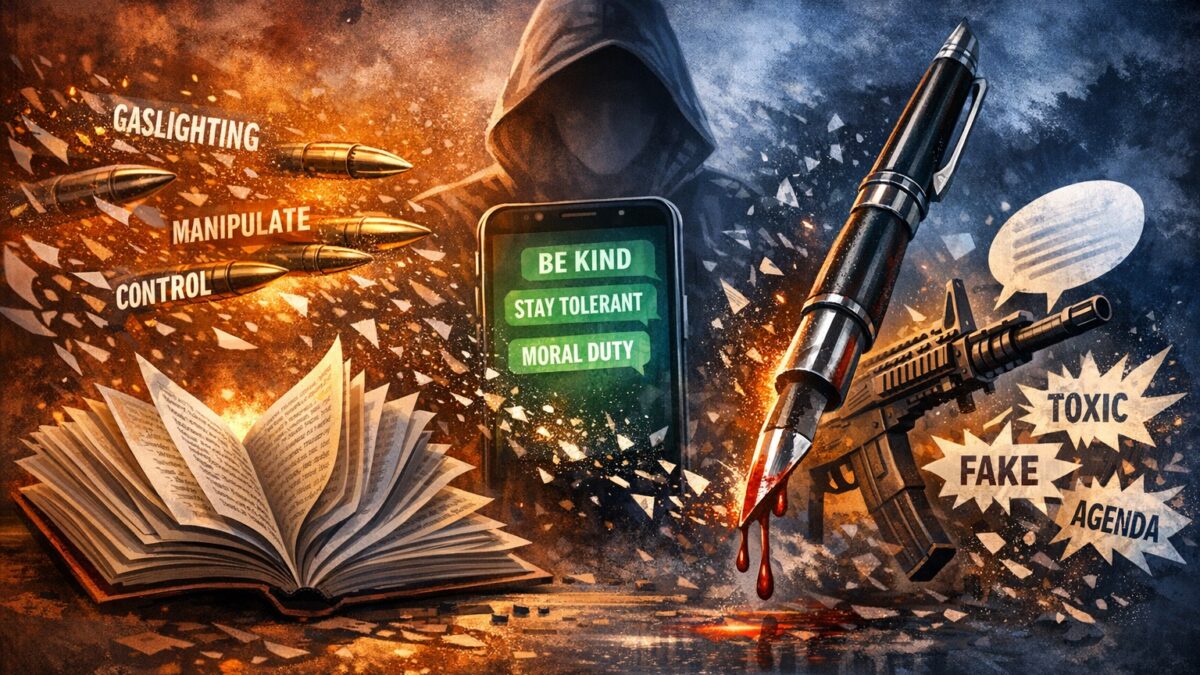
Every single word was weaponized – When this person said “Tolerant”, it didn’t mean that they were tolerant; it meant that they wanted the other person to shut up. “Kindness” didn’t mean genuine compassion—it meant stop making me uncomfortable. “Safe space” didn’t mean protecting vulnerability—it meant protecting stupidity from accountability.
And if others objected? Then they were the intolerant ones, the unkind ones, the ones destroying the safe space.
That’s the genius of weaponized language – you can use words like “kindness” and “tolerance” in order to attack people. Not very kind or tolerant behavior, to be sure!
What This Has to Do With Writer’s Effect (Everything, Actually)
Every exam passage is an exercise in weaponization. Some politician says “we need common sense solutions.” A travel writer describes a place as “untouched by modernity.” An opinion piece calls something “just basic human decency.”
These aren’t neutral descriptions. They’re moves. Strategic deployments of language designed to make you think a certain way, feel a certain way, accept certain premises without questioning them.
When I write on a student’s paper “analyze the effect of the word choice,” what I mean is: Why did the writer choose this word instead of any other word? What is it trying to make you believe? What alternatives is it trying to make invisible?
The student who writes “the writer uses ‘passionate’ to show the protesters care a lot” gets a Level 3.
The student who writes “the writer’s choice of ‘passionate’ over alternatives like ‘angry’ or ‘violent’ pre-emptively legitimizes the protest by framing emotion as conviction rather than instability—this rhetorical move attempts to control reader sympathy before any actions are described” gets a Level 6.
The difference? One student is describing. The other is exposing.
And that exposure is exactly what I needed to do with the WhatsApp moral defender.
The Gen Z Toolkit: Words for What We’ve Always Known Was Happening
I’m not Gen Z, but I appreciate what they’ve done with language. They’ve created a vocabulary for calling out manipulation tactics that previous generations just had to endure.
Gaslighting. When someone makes you question your own perception of reality. When Mr. Moral Defender suggests that my legitimate frustration with stupidity is actually my failure to be kind, that’s gaslighting. The problem isn’t the stupid comment—it’s my reaction to it. Suddenly I’m doubting myself: Am I being too harsh? Am I the problem here?
Virtue signaling. Performing morality for social credit without any actual commitment to the values being performed. I guarantee you Mr. Moral Defender isn’t actually tolerant of perspectives he disagrees with. But by being the first to call for tolerance, he gets to position himself as morally superior. The words do the work; the actions never need to materialize.
Tone policing. Dismissing the content of an argument by attacking how it’s delivered. “You need to be more respectful” almost always means “your anger is inconvenient to me.” It’s a way of avoiding engagement with substance by focusing on style.
These terms are useful because they make visible what was always there. And that visibility is precisely what we’re teaching in writer’s effect analysis.
When an exam passage describes protesters as “rioters” versus “activists,” that’s not just word choice—it’s an attempt to control your emotional and moral response before you’ve even heard what the protest is about. The writer is priming you.
When a travel piece talks about a place being “authentic” and “unspoiled,” it’s not just description—it’s othering, exoticizing, and probably erasing the actual lives of people who live there in favor of a Western fantasy.
When a politician says “hardworking families,” they’re not just identifying a demographic—they’re creating an in-group and implying that anyone outside that category (single people? unemployed people? lazy families?) is less deserving.
This is what I mean by weaponization. The words have dictionary definitions, sure. But their function in context is to manipulate.
Context Is the Only Truth That Matters
Here’s what I couldn’t say in the WhatsApp group but what I want to say now:
The word “tolerant” means nothing without context.
Is Mr. Moral Defender tolerant of my intolerance for stupidity? No. Is he tolerant of perspectives that challenge his moral framework? No. Is he tolerant of direct communication that makes him uncomfortable? Absolutely not.
So what does his call for tolerance actually mean? It means tolerance for the thing he wants to defend, and intolerance for the thing I want to critique. It’s completely asymmetrical. The word “tolerant” is being deployed strategically to achieve a specific outcome, and that outcome has nothing to do with genuine openness.
This is Karl Popper’s paradox of tolerance: if you tolerate everything, including intolerance, then intolerance wins. Genuinely tolerant people must be intolerant of intolerance. Which means true tolerance requires judgment, discernment, and the willingness to draw lines.
But that’s not what Mr. Moral Defender wants. He wants the appearance of tolerance—which is actually just conflict avoidance dressed up in moral language.
And this is exactly what I need my students to recognize in their exam texts.
When a writer says “reasonable people can disagree,” ask: who counts as reasonable in this framework? When they say “balanced perspective,” ask: balanced between which positions, and why those specifically? When they appeal to “common sense,” ask: common to whom?
Context determines meaning. Always. Without exception.
The Connection to Writer’s Effect: Making It Real
When I’m marking papers and I see a student write “the writer uses emotive language to make the reader feel sad,” I die a little inside.
Because that student is doing exactly what I did in the WhatsApp group—accepting the surface meaning without interrogating the function.
The question isn’t whether the language is emotive. The question is: Why is the writer trying to make you sad? What does your sadness make you more likely to accept? What perspectives does this emotional manipulation obscure?
Let me give you an example from an actual past paper:
“The refugees arrived devastated, having lost everything they once held dear.”
A weak analysis: “The word ‘devastated’ is emotive and makes us feel sorry for the refugees.”
What I’d write: “The writer’s choice of ‘devastated’ frames the refugees primarily through their victimhood, which—while generating sympathy—also strips them of agency and complexity. The passive construction ‘having lost’ obscures who or what caused the loss. This emotional weaponization creates empathy while potentially avoiding harder questions about systemic causes or political responsibility. The reader’s sadness becomes a substitute for analysis.”
See the difference? I’m not saying the writer is wrong to generate sympathy. I’m saying that all language choices have implications, and our job as readers is to be conscious of those implications rather than passively absorbing them.
That’s what Mr. Moral Defender was trying to prevent. Consciousness. Critical analysis. The willingness to interrogate rather than accept.
What “Tolerant” Actually Looks Like
You know what’s actually tolerant? Being able to hear criticism without immediately performing wounded morality. Being able to distinguish between disagreement and attack. Being willing to defend your positions with arguments rather than emotional manipulation.
You know what’s not tolerant? Using the word “tolerant” to shut down discourse.
This applies directly to your exam analysis. When a writer uses words like “obviously,” “clearly,” “everyone knows,” or “it’s just common sense”—that’s not confidence in their position. That’s an attempt to make their position seem self-evident so you don’t question it.
Real confidence welcomes scrutiny. Weaponized language tries to pre-empt it.
In your exam response, you might write:
“The writer’s repeated use of ‘obviously’ attempts to establish consensus where none may exist. By framing their position as self-evident, they weaponize assumed agreement to discourage critical examination. This rhetorical strategy reveals anxiety about the strength of the argument—truly obvious claims rarely need to be labeled as such.”
That’s not just good analysis. That’s seeing through the manipulation.
The Real Lesson (Or: Why I’m Still Angry)
I’m still annoyed about that WhatsApp exchange. Not because I think I should have “won” the argument—there was no argument, just a performance of morality that successfully shut down conversation.
I’m annoyed because it’s the same pattern I see everywhere. In politics, in social media, in corporate communications, in everyday discourse. People say beautiful-sounding things and expect that to be enough. They use words like shields—tolerance, kindness, safety, respect—and if you question how those words are being deployed, you’re the villain.
But here’s what I’ve learned from years of teaching IGCSE English:
Words only mean what they mean in context. Claims only matter if actions support them. And the person who says “I’m tolerant” isn’t necessarily tolerant—you have to look at what they’re actually tolerating and what they’re actually suppressing.
This is the core skill of textual analysis. This is the core skill of being a functioning adult who can’t be easily manipulated.
When you read a text—any text, exam passage or WhatsApp message—your job is to ask:
- What is this language trying to make me do?
- What alternatives is it trying to hide?
- Who benefits from me accepting this framing?
- What would change if different words were used?
That’s not cynicism. That’s literacy.
Conclusion: Trust Nothing, Interrogate Everything
Mr. Moral Defender in my WhatsApp group taught me something valuable, even if he didn’t mean to. He taught me that the best way to manipulate people is to use the most virtuous-sounding language possible. Make your weapon so beautiful that questioning it seems like a moral failing.
But once you see it, you can’t unsee it.
And that’s the point of education, isn’t it? Not to make you compliant. Not to make you polite. But to make you dangerous—dangerous because you can’t be controlled by pretty words anymore.
So the next time someone tells you to be more tolerant, ask them what they want you to tolerate. The next time someone creates a “safe space,” ask whose safety matters and whose doesn’t. The next time language sounds too good to be true, remember: it probably is.
And when your exam asks you to analyze writer’s effect?
Don’t just describe what the writer did.
Expose why they did it.
That’s not just how you get the marks.
That’s how you survive.